
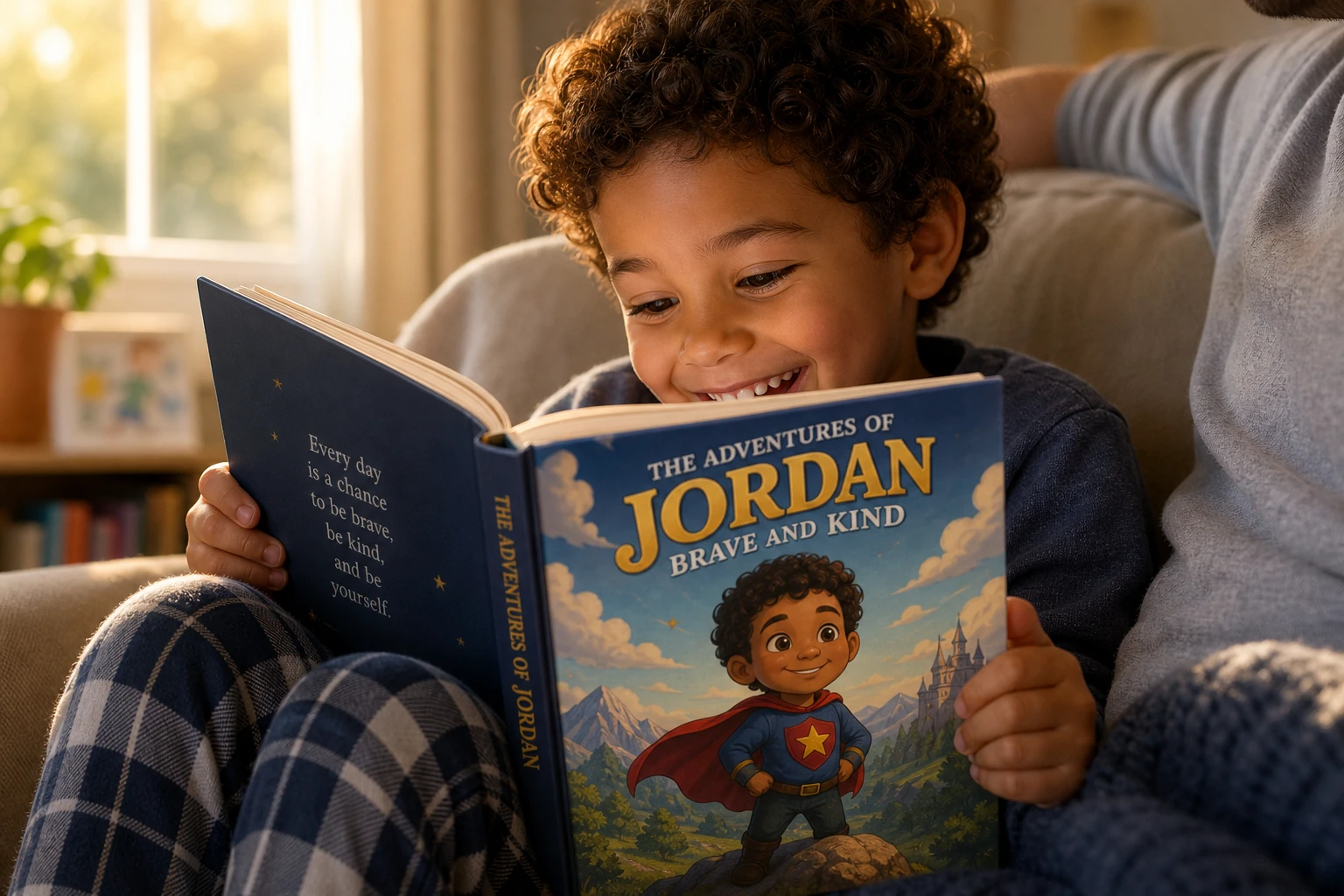
Do Personalized Books Really Help Reluctant Readers? An Honest Answer
If your child slides off the couch the second you reach for a book, you have probably wondered whether a personalized story (the kind where your kid is the hero) would change anything, or whether it is just a cute gift with their name stamped on the front. Fair question. Here is the honest answer, the part most companies selling these books will not tell you, and a small plan you can actually use at home.
Is reluctant reading actually that common?
Yes, and it is getting more common, not less. In the UK, just 1 in 3 children and young people (32.7%) say they enjoy reading in their free time, the lowest level since the survey began, according to the National Literacy Trust (2025). The drop is not just a UK thing. Reporting on US data, University of Miami News (2025) notes that the share of 13-year-olds who read for fun almost every day fell from 27% in 2012 to 14% in 2023.
And it starts young. Scholastic's Kids & Family Reading Report (2023) found that reading frequency and enjoyment decline as kids grow up, with marked declines by age 9 that do not rebound. Frequent readers fall from 46% of 6-to-8-year-olds to 32% of 9-to-11-year-olds. So if your once-eager listener has cooled off around early elementary age, that is not a parenting failure. It is the pattern.
Why do kids resist reading in the first place?
Usually it is not about ability. It is about how reading feels to them. Reading Rockets points to a few familiar culprits: kids get turned off during school instruction, they are bored or distracted, or they are forced to grind through books that are simply too hard. The fix they describe is not a trick. It is matching kids with high-interest, age-appropriate books tied to what they already love, so reading feels like a pleasure instead of a chore.
That word, interest, is the whole game. A child who finds the right book leans in. A child handed the wrong one finds a reason to leave the room.
So does making my child the hero help?
Yes, on the part that matters most at the start: getting the book opened and getting your child engaged. There is almost nothing a five-year-old finds more interesting than themselves, and that is exactly the hook reluctant readers need.
There is research behind the feeling. In a home study of parents and toddlers, children and parents showed significantly more smiles and laughs with personalized books than with non-personalized ones, and more back-and-forth talk than even with the child's favorite book, per the Journal of Early Childhood Literacy (2013). More smiling, more talking, more sticking with it. For a kid who normally checks out after two pages, that is a real shift.
Seeing yourself in a book matters for older kids too. The National Literacy Trust (2022) found that 2 in 5 children (38.9%) struggle to find books with characters like them, rising to 53.1% among 8-to-11-year-olds, and that 38.9% agreed reading about characters like them makes them feel more confident. This is the idea behind Dr. Rudine Sims Bishop's well-known framing, profiled by Reading Rockets, that children need books that work as mirrors so they can see reflections of themselves. A book where your child is literally the hero is about as clear a mirror as it gets.
The honest caveat most sellers skip
Here is the part you deserve to hear straight: a name alone is not a reading lesson.
In a randomized study, a storybook about sharing that only inserted the child's name did not improve preschoolers' comprehension of the moral or change their sharing behavior compared with a non-personalized version, reported in the Early Childhood Education Journal (2021). The researchers concluded that "nominal personalization" (just dropping in a name) does not by itself help a child understand a story and apply it to their own life. The content of the story still has to do the work.
So personalization is a doorway, not a destination. It lowers the barrier to opening the book and raises engagement once it is open. It does not magically teach phonics, build fluency, or replace the daily reading habit. Any company telling you a name on the cover will turn a struggling reader into a strong one is overselling. We would rather you trust us with the true version.
If a name is not enough, why bother?
Because getting your child to want to open a book is the hardest and most valuable step, and it pays off for years. Twice as many children who enjoy reading in their free time have above-average reading skills as those who do not (34.2% versus 15.7%), per the National Literacy Trust. The benefits reach past test scores. A study of more than 10,000 adolescents found that reading for pleasure early in childhood was linked to better cognitive performance, fewer signs of stress and depression, and better attention later on, according to the University of Cambridge (2023).
You cannot get any of that from a book your child refuses to touch. Engagement is the on-ramp to everything else, and a hero book is a genuinely good on-ramp.
A short at-home plan that actually works
Use the personalized book to break the ice, then build the habit around it. None of this is complicated.
Let them choose. Choice is one of the most reliable ways to get kids reading. Scholastic (2017) suggests treating it as teamwork: ask what makes a book boring, then hunt together for the right thing, whether that is comics, fact books, or a story starring your kid.
Keep it fun, not a drill. The American Academy of Pediatrics advises following your child's interests and reminds parents that you do not have to finish a story if your child loses interest, via HealthyChildren.org (2018).
Read aloud, even past the age you think you should stop. A few minutes a day counts. The personalized book is a perfect read-aloud because your child is the star and will ask for it again.
Use the hero book as a bridge. After they have loved being the main character, point them to other books about the same theme, animal, or adventure. You are transferring the excitement, not relying on the name forever.
Hero book vs generic storybook: an honest comparison
What matters | Personalized hero book | Generic storybook |
|---|---|---|
Getting a reluctant kid to open it | Strong. Kids are drawn to seeing themselves | Hit or miss, depends on the topic |
Engagement during reading | Higher smiles, laughs, and talk (2013 study) | Varies by the child's interest |
Feeling seen and confident | Acts as a mirror (NLT 2022) | Only if a relatable character appears |
Teaching reading skill on its own | No. A name does not do this (ECEJ 2021) | No. No single book does |
Keepsake value | High. It is theirs, by name | Low to medium |
If you want to see what a story like this looks like before deciding, browse a few of our example books, or read more about how a personalized children's book is built around your child. When you are ready, you can create your child's book in a few minutes and start with a story they will actually want you to read.
Frequently asked questions
Will a personalized book fix my child's reading problem?
No, and we would not trust anyone who promised that. A name on the cover gets the book opened and keeps your child engaged, which is the hardest first step. It does not teach reading skill by itself. Research in the Early Childhood Education Journal (2021) found that adding a child's name alone did not improve comprehension. The daily habit and the right level of book still matter.
What age is a hero book best for?
It works well across early childhood, roughly ages 0 to 10, because the appeal of seeing yourself does not expire. Younger kids respond to the joy and the read-aloud moment, while older kids respond to feeling seen. The National Literacy Trust (2022) found the struggle to find relatable characters actually peaks at ages 8 to 11.
My child only likes screens and comics. Is that a lost cause?
Not at all. Comics and fact books count. Scholastic (2017) recommends broadening what counts as reading and finding the right level together. A book starring your own child is one more format to try, and it tends to win attention that a generic title would not.
Is reading aloud still worth it once my child can read alone?
Yes. Reading aloud stays valuable well past the early years, and it is one of the best ways to keep a reluctant reader connected to books. The American Academy of Pediatrics (2018) suggests following your child's interests and keeping it fun, even just a few minutes a day. A personalized book is an easy one to reach for because they will request it.
Does it really matter if my child enjoys reading or just gets it done?
Enjoyment matters a lot. Twice as many children who enjoy reading in their free time have above-average reading skills as those who do not (34.2% versus 15.7%), per the National Literacy Trust, and reading for pleasure is linked to better wellbeing and attention, per the University of Cambridge (2023). Building the want is the whole point.