
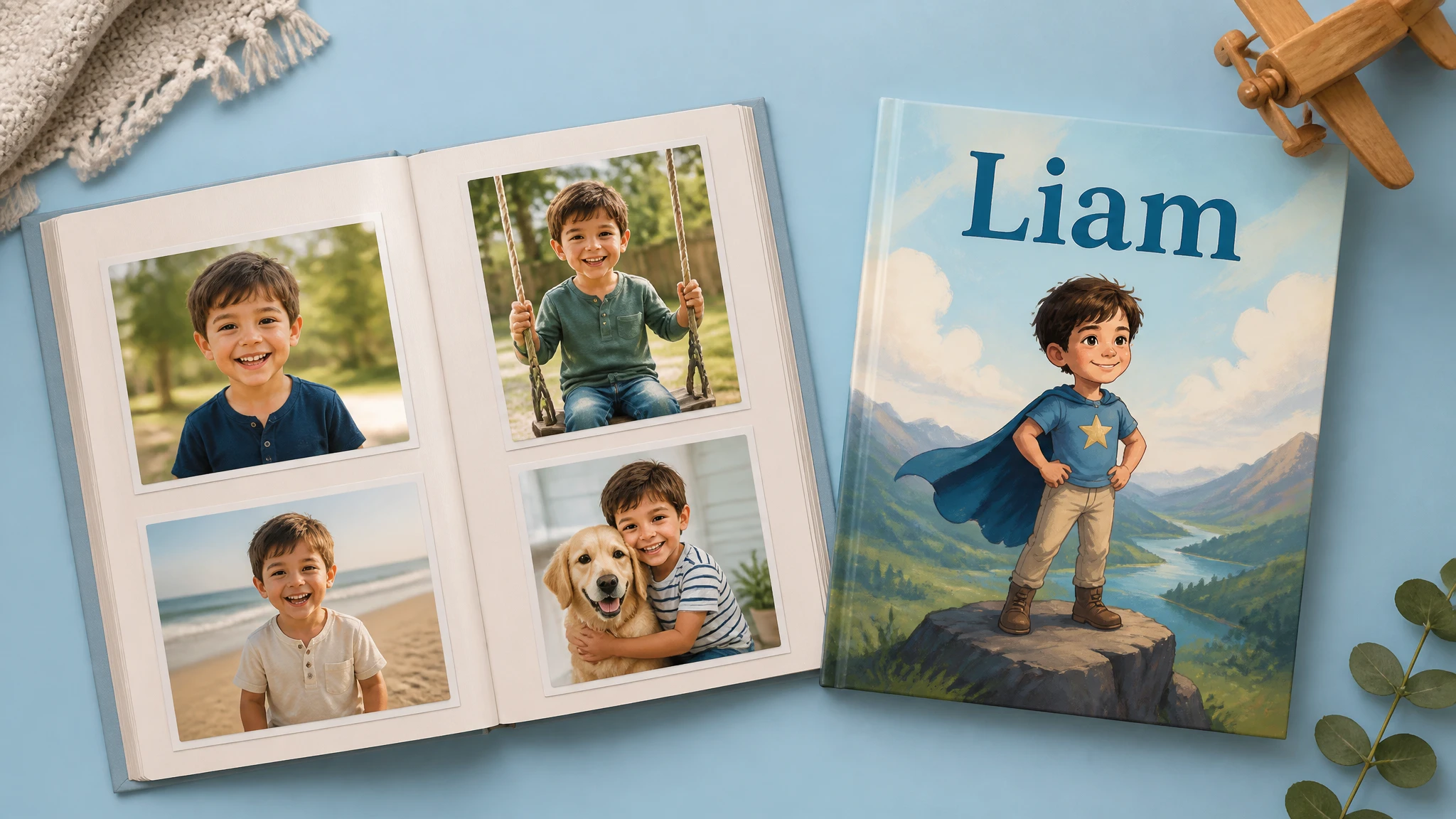
Photo Book or Story Book? How to Choose the Right Keepsake for Your Child
You want to make something your child will keep. The question that stops most parents is which something. A photo book that holds the year you just lived, or a story book where your child is the hero of an adventure. They feel similar from the outside (both are personal, both are printed, both end up on the shelf) but they do very different jobs, and they shine at different moments in a child's life.
Here is the honest version, with no pretending one is better than the other.
What is the actual difference between a photo book and a story book?
A photo book preserves what already happened. A story book invents something new with your child inside it. That is the whole split, and almost every other decision follows from it.
A photo book is memory. It is the beach trip, the first birthday, the grandparents visiting from far away. You are curating real moments so they do not get lost in a camera roll nobody scrolls back through. A photo book for kids turns a year of your phone into something a small person can actually hold and flip through.
A personalized children's book is imagination. Your child is not in the photos, your child is in the plot. They sail the boat, they find the dragon, they save the day. It is a story that did not exist before and stars someone who is four years old and sitting on your lap.
Which one is right for my child? An honest comparison
There is no universal winner. There is a winner for the specific thing you are trying to do. This table is the fastest way to see which side your gut is already on.
| Photo book | Story book (personalized) | |
|---|---|---|
| Best for | Preserving real memories and moments you already lived | Adventure, imagination, and making your child the hero |
| What it captures | Who your child was this year, the faces, the places | Who your child could be, brave, kind, curious |
| Who it is really for | Parents and grandparents as much as the child | The child first, the grown-up reading along second |
| Best age | Any age, including newborns and first years | Roughly 1 to 8, the prime read-aloud and early-reader window |
| Re-reading | Revisited on occasions and milestones, ages beautifully | Read again and again, often the same night, at bedtime |
| The bonding moment | Pointing and remembering together, "look, that's you" | Snuggling up to read a story where your child is the star |
When a photo book is the better keepsake
Choose a photo book when the thing you want to hold onto already happened. A first year goes by fast and the moments live trapped in a phone. Printing them gives a baby or toddler something real to touch, and gives you and the grandparents something to sit with on a quiet afternoon.
Photo books also win when the child is very young. There is no plot to follow yet, but there is everything to remember. The American Academy of Pediatrics points out that it is never too early to share books with a baby, and that reading together is "special time for you and your baby to connect" that "helps your little one feel loved and secure," per HealthyChildren.org (AAP, 2024). A book of familiar faces is exactly the kind of thing a baby leans into.
Photo books grow with you in a different way
A story book gets read hard for two or three years and then loved from the shelf. A photo book does the opposite. It quietly gains value as the child gets older and the people in it change. The photo of a grandparent, a first home, a baby who is now in school, those get more precious, not less.
When a personalized story book is the better keepsake
Choose a story book when you want your child inside the adventure, not just on the page. This is the keepsake that gets read at bedtime until you both know it by heart, and there is real warmth in that repetition. In a small home study of parents and toddlers, researchers found children and parents shared significantly more smiles and laughs with personalized books than with non-personalized ones, suggesting these books spark a particular kind of joint, face-to-face engagement during shared reading (Kucirkova, Messer & Whitelock, Journal of Early Childhood Literacy, 2013).
There is also something a generic book cannot offer. A lot of kids do not see themselves in the stories they read. A National Literacy Trust survey found that 2 in 5 children (38.9%) say it is difficult to find books with characters or people like them, rising to 53.1% among 8 to 11-year-olds, and 38.9% agreed that "reading about characters that are like me makes me feel more confident about myself" (National Literacy Trust, 2022). A book where the hero has your child's name and your child's face is a mirror, in the sense the educator Rudine Sims Bishop made famous: a place where a child can "find themselves, see reflections of themselves" (Reading Rockets, on Bishop's 1990 framework).
What personalization can and cannot do
Here is the honest part, because it matters. Putting a child's name in a book is lovely, but it is not a shortcut to teaching a lesson. A randomized study found that a storybook about sharing which only added the child's name did not increase preschoolers' understanding of the moral or their actual sharing behavior compared to a non-personalized version (Kruse, Faller & Read, Early Childhood Education Journal, 2021). The name is the warm hook, the delight of "that's me." The story still has to be a good story. We would rather tell you that than oversell it.
The thing both keepsakes share
Whichever you choose, the real value is the same, and it is the bit no app can manufacture for you. It is you and your child, close together, with a book between you. Reading Rockets describes reading with a child as "a great way to bond," a time to "relax together, snuggle up, and share a story," which "helps kids associate books with the joy of spending time with their parents" (Reading Rockets).
That bonding is worth protecting, because the pull of reading fades as kids grow. The National Literacy Trust reports that just 1 in 3 (32.7%) of 8 to 18-year-olds say they enjoy reading in their free time, the lowest level since their survey began (National Literacy Trust, 2025). A book your child genuinely wants to return to, whether it is full of their own face or their own adventures, is a small, real way to keep that door open. And reading for pleasure is worth the door: National Literacy Trust research found twice as many children who enjoy reading in their free time have above-average reading skills than those who do not (34.2% versus 15.7%) (National Literacy Trust, 2024).
So which should you make?
If you want to hold a year in your hands, make a photo book. If you want your child to be the hero, make a story book. If you are buying a gift and you are not sure, a story book travels better, because it does not depend on the giver having the family photos.
And if you genuinely cannot decide, that is a fine reason to make both over time. Plenty of families do exactly that: the photo book for the milestone, the story book for bedtime. When you are ready, you can start creating yours and see how the finished pages feel before you print a thing.
Frequently asked questions
What is the difference between a photo book and a personalized story book?
A photo book preserves real memories using your own photos, so it is best for moments that already happened. A personalized story book is a new, fictional adventure with your child written in as the hero. One looks back, the other invents something new.
Which is better for a baby or toddler?
For the first year or two, a photo book of familiar faces is often the easier fit, because there is no plot to follow yet. That said, it is never too early to share books with a baby. The AAP notes reading together is "special time for you and your baby to connect" that helps them "feel loved and secure" (HealthyChildren.org, 2024). A simple personalized story works well from around age one too.
Which makes a better gift?
A personalized story book usually travels better as a gift, especially from a grandparent or friend, because it only needs the child's name and a few details, not access to the family's private photos. A photo book is wonderful but works best when you are the one with the camera roll.
Will a personalized book actually teach my child a lesson?
It can help, but be realistic. A randomized study found that just inserting a child's name into a story about sharing did not, on its own, improve their understanding of the lesson or their behavior (Kruse, Faller & Read, 2021). The personalization is a delightful hook. The story itself, and you reading it with them, do the real work.
Will my child actually re-read it?
Story books tend to be re-read the most, often the same one many nights in a row, which is a feature, not a flaw. Photo books are revisited more on occasions and milestones and tend to age beautifully as the people in them change. Both reward keeping.
Can I make both?
Yes, and many families do. A common rhythm is a photo book once a year to capture the real moments, and a personalized story book or two for the bedtime shelf. They are not competitors, they just do different jobs.