
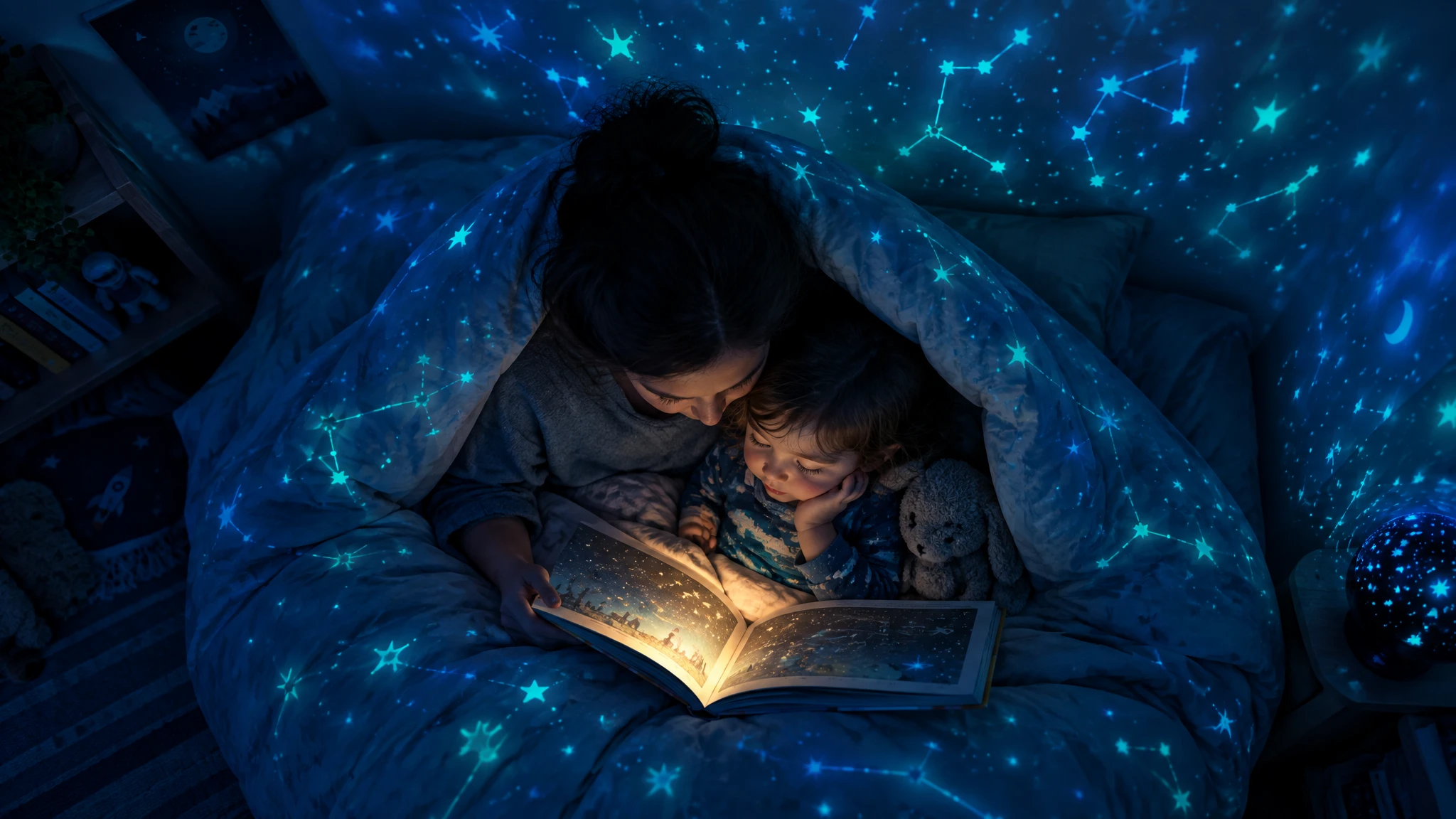
The Ten Minutes That Matter Most: Why Bedtime Stories Build More Than Sleep
Some nights you are tired, the dishes are still in the sink, and the last thing you want to do is read Goodnight Moon for the four-hundredth time. You do it anyway. You pull the small body in close, find the page, and start. And somewhere around the third line, the squirming stops. That is the part nobody tells you about bedtime stories. They are not really about the book.
This is a guide to what those ten minutes actually do, told honestly. Some of it is backed by decades of research. Some of it is just what every parent already knows in their bones. Both are worth taking seriously.
What are the real benefits of bedtime stories?
Bedtime stories do three things at once: they build your child's brain through language, they wire reading to feelings of safety and love, and they give the two of you a small, repeatable ritual that becomes memory. The sleep is almost a side effect.
Start with the brain. The American Academy of Pediatrics, on its HealthyChildren guidance (2024), recommends reading together starting at birth and continuing at least through kindergarten, and notes that reading proficiency by third grade is a meaningful predictor of high school graduation. That is a long arc to hang on a picture book. But it starts that early, and it starts that small.
The clearest number comes from Ohio State University. Researchers found that children read about five books a day hear roughly 1.4 million more words by kindergarten (Logan et al., Ohio State, 2019) than children who are never read to. Even one book a day adds around 290,000 words. They named it the million word gap, and the closing of it happens on ordinary couches, in ordinary pajamas, ten minutes at a time.
Why does a parent's voice matter so much?
Because long before a baby understands a single word, they are learning from the sound of you. The AAP points out that babies absorb "the rhythm, tones, sounds and flow of speech" (AAP, 2024), which feeds early brain development and future language. Reading together, they add, is special time to connect that helps a child feel loved and secure.
That security is the quiet engine underneath all of it. When the same voice reads the same story in the same chair, a child learns that books live in a warm place. Reading Rockets describes reading aloud as "a great way to bond with your child", a time to relax together and snuggle up, which helps kids associate books with the joy of being with their parents. You are not just teaching words. You are teaching that reading feels like home.
The single most important activity for building the knowledge required for eventual success in reading is reading aloud to children. (Becoming a Nation of Readers, 1985, as highlighted by PBS KIDS for Parents.)
Is it really worth it on the nights I am exhausted?
Yes, and the research is gentler about it than you might expect. The AAP advises making reading aloud enjoyable and child-led (AAP, 2018): let your child pick the book even if it is the same one again, follow their interests, and feel free to stop if they lose interest. Reading every day, "even if only for a few minutes," is the goal. Nobody is grading you on finishing the chapter.
There is good news about the long game too. A University of Cambridge study of more than 10,000 adolescents found that children who read for pleasure early in childhood (Cambridge, 2023), between ages three and ten, later showed better cognitive performance, fewer signs of stress and depression, and improved attention in their teens. The phrase that matters there is for pleasure. The nights you keep cozy and low-pressure are the nights that count.
The window is smaller than you think
Here is the honest part. Bedtime reading does not last forever, and it fades earlier than most parents expect. Scholastic's research found that being read aloud to peaks at age five and then begins to decline (Scholastic, 2019). Many parents stop once a child can read alone, assuming the job is done.
The children disagree. In an earlier Scholastic survey, 83% of kids ages 6 to 17 said they loved being read aloud to (Scholastic and YouGov, 2015), and 40% of 6-to-11-year-olds wished their parents would keep doing it, because it was special time together. The book was never the point for them either.
Does reading for pleasure actually pay off later?
It does, and the gap is wide. The National Literacy Trust reports that twice as many children who enjoy reading in their free time have above-average reading skills (NLT, 2024) compared with those who do not, 34.2% versus 15.7%. Reading for pleasure also supports wellbeing, empathy, and confidence. The bedtime ritual is where the pleasure gets planted.
Even the bookshelf does some of the work. A 27-nation study found that children growing up in homes full of books get about three more years of schooling (Evans et al., 2010) than children from bookless homes, independent of their parents' education or class. The keepsake books on the shelf, the ones you reach for again and again, are part of that quiet message that this is a house where stories belong.
| The ten minutes give your child | How it shows up |
|---|---|
| Words | Up to 1.4 million more by kindergarten (Ohio State, 2019) |
| Safety | Books linked to your voice and feeling loved (AAP, 2024) |
| Wellbeing | Less stress, better attention as a teen (Cambridge, 2023) |
| A ritual | A memory you both keep |
Where personalized and keepsake books fit (honestly)
We make personalized books where your child is the hero, so it is fair to ask whether that does anything extra, or whether it is just a nice gift. The honest answer is both, with a caveat.
The caveat first. Research is clear that sprinkling a child's name into a generic story is not a shortcut to comprehension. One randomized study found that simply inserting a child's name (Kruse, Faller & Read, 2021) did not improve their understanding of a story's moral or change their behavior compared with a non-personalized version. A name on the page is not a magic ingredient, and we would rather tell you that than pretend otherwise.
What does seem to matter is the shared moment a personal book creates. In a home study of toddlers and parents, children and parents showed significantly more smiles and laughs with personalized books (Kucirkova, Messer & Whitelock, 2013) than with non-personalized ones, and more talking back and forth. The value is not the name. It is the lean-in, the pointing, the "that's you," the extra few minutes you both want to stay on the page.
So that is where we sit, plainly. A personalized book that puts your child inside the story will not raise a test score on its own. What it can do is make the ten minutes a little stickier, a little more theirs, and a lot more likely to be kept. When you are ready to make one, you can start your child's story here. And if you are looking ahead to a new baby, a personalized book makes a baby shower gift that gets read long after the onesies are outgrown, because the AAP reminds us it is never too early to start.
Frequently asked questions
At what age should I start reading bedtime stories?
From birth. The American Academy of Pediatrics recommends shared reading starting in infancy (AAP, 2024) and continuing at least through kindergarten. A newborn will not follow the plot, but they are soaking up the rhythm of your voice and learning that books mean closeness.
How long should a bedtime story be?
As long or as short as your child stays with it. The AAP says to read aloud daily "even if only for a few minutes" (AAP, 2018) and to stop if they lose interest. Ten minutes of warm, willing reading beats thirty minutes of a battle every time.
Should I keep reading aloud after my child can read on their own?
Yes, if you both enjoy it. Read-aloud tends to drop off after age five (Scholastic, 2019), yet most kids still love it. In one survey, 83% of children ages 6 to 17 loved being read to (Scholastic, 2015). Independent reading and being read to can happily coexist.
Does it matter if I read the same book over and over?
Not at all, and the repetition is good for them. The AAP explicitly suggests letting your child choose the book "even if it means reading the same book over and over" (AAP, 2018). Familiarity is part of the comfort, and hearing the same words repeatedly helps young children master them.
Do personalized books help my child learn more?
Honestly, not by the name alone. Research shows that inserting a child's name (Kruse, Faller & Read, 2021) did not improve comprehension or behavior on its own. What personalized books can do is spark more smiles and shared talk (Kucirkova et al., 2013) during reading, which is its own quiet win.
What if my child resists reading at bedtime?
Follow their lead and keep it low-pressure. The AAP recommends following your child's interests (AAP, 2018) and never forcing a finish. The aim of reading for pleasure, as the Cambridge research found, is that it stays a pleasure (Cambridge, 2023). Let them pick, let them wriggle, and try again tomorrow.