Why Your Child Wants to Be the Hero of Their Own Story
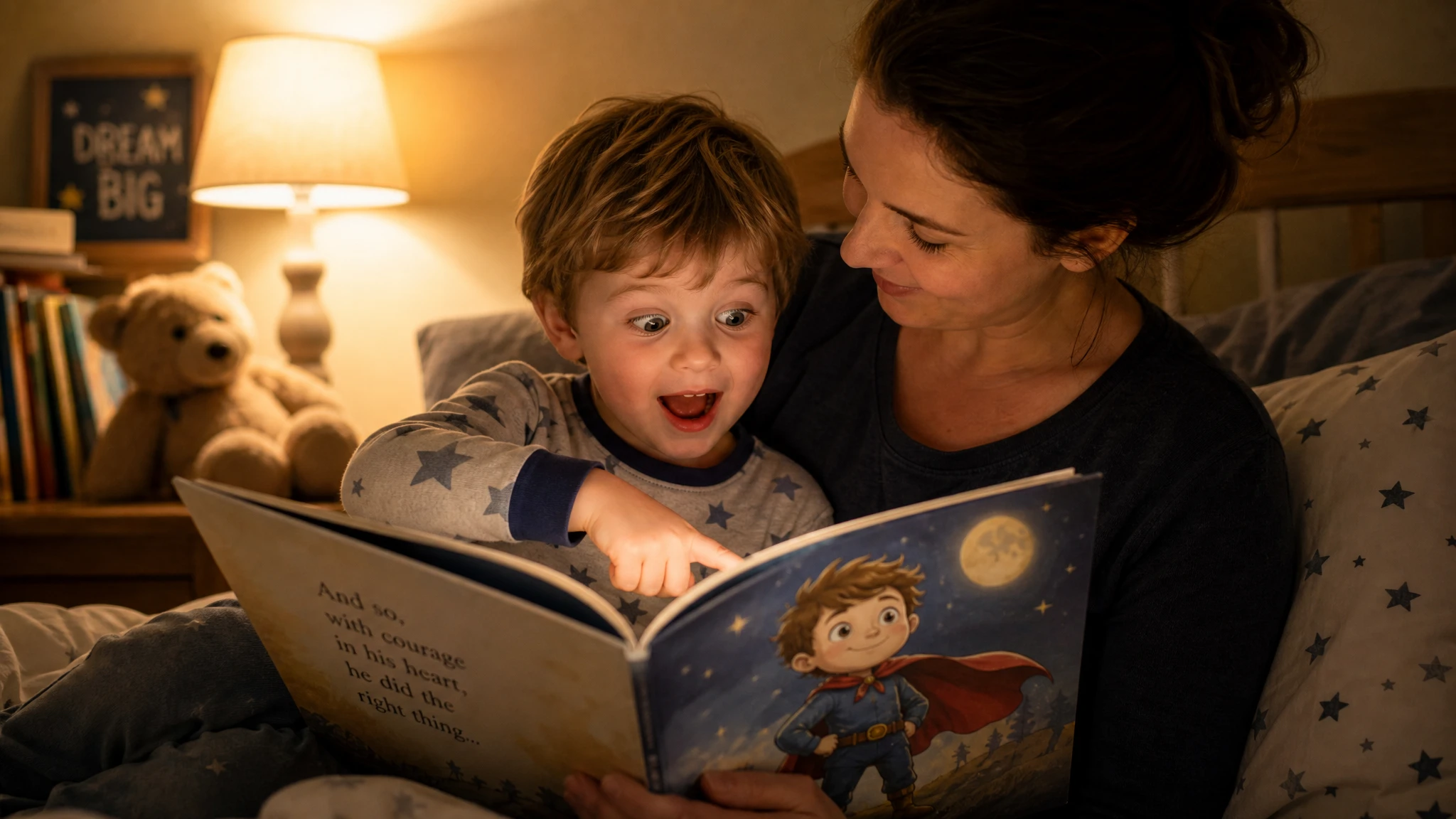
Watch a four-year-old find their own name on a page and something shifts. They sit up. They point. They want you to read it again, and then again, and then a third time when you were really hoping to turn off the light. It is one of the most reliable reactions in parenting, and it tells you something simple: kids are wildly interested in themselves.
Which is funny, because in almost every book on the shelf, the hero is somebody else. A rabbit. A princess. A boy named Max who is not your Max. Your child meets pirates and astronauts and a hundred talking animals, and the one character they keep not meeting is the one they know best.
Why does my child love being the main character?
Because seeing yourself in a story is rare, and rare things feel special. Most children spend their reading lives as a guest in someone else's adventure. When the adventure is suddenly about them, it stops being something they observe and becomes something they belong to.
This is not a marketing idea. The late Dr. Rudine Sims Bishop gave us the language for it back in 1990 with her "mirrors, windows, and sliding glass doors" framework (profiled by Reading Rockets): books can be windows into other lives, but they also need to be mirrors, so a child can "find themselves, see reflections of themselves." Most kids get plenty of windows. Mirrors are harder to come by.
The numbers back up how common that gap is. In a 2022 survey, the National Literacy Trust found that nearly 2 in 5 children (38.9%) say it is hard to find books with characters like them, rising to more than half (53.1%) among 8 to 11-year-olds. The same research found that 38.9% agreed reading about characters like themselves makes them feel more confident.
The honest part: a name on the cover is not the whole trick
Here is where we want to be straight with you, because honesty is kind of our whole thing. Slapping your child's name into an off-the-shelf story does not magically do the heavy lifting.
Researchers actually tested this. In a 2021 study published in the Early Childhood Education Journal, Kruse, Faller and Read found that a storybook personalized with only the child's name did not improve preschoolers' understanding of the story's moral, or their behavior, compared with a regular version. The lesson is not "personalization doesn't work." The lesson is that a name alone is thin. The child has to actually be the protagonist, doing the brave or kind or clever thing, for the story to land.
A name makes a child notice the book. Becoming the hero is what makes them care about it.
So when we say your child should be the hero, we mean the real thing: they make the choice, they help the friend, they reach the top of the hill. Not a sticker with their name on someone else's journey.
Does seeing themselves actually make kids more engaged?
Yes, and there is lovely evidence for it in the moment of reading together. In a home study published in the Journal of Early Childhood Literacy (Kucirkova, Messer and Whitelock, 2013), parents and toddlers smiled and laughed significantly more with personalized books than with non-personalized ones, and the children were more vocally active with the personalized book than even with their own favorite book. More smiling, more talking, more leaning in. That is exactly the climate where a love of reading grows.
And it matters because the love of reading is genuinely under pressure. The National Literacy Trust reported in 2025 that just 1 in 3 children and young people (32.7%) say they enjoy reading in their free time, the lowest level since their survey began. Scholastic's Kids & Family Reading Report finds the same downward drift, with reading for fun dropping noticeably by around age 9 and not bouncing back. Anything that makes a young child say "again" is worth holding onto.
Confidence, identity, and the kid who decides they are "a reader"
There is a quiet identity question hiding in every bedtime story: do I belong in books? When the answer is yes, because the kid on the page is brave and kind and capable and also happens to be them, something useful happens to how they see themselves.
Reading for pleasure is tied to more than vocabulary. The National Literacy Trust notes that twice as many children who enjoy reading in their free time have above-average reading skills compared with those who don't (34.2% versus 15.7%), and around a quarter (26.0%) of those who read regularly say it helps them feel confident. A University of Cambridge study published in 2023 went further: children who read for pleasure early (ages 3 to 10) showed better cognitive performance, fewer signs of stress and depression, and better attention in adolescence.
None of that comes from a single book, personalized or not. It comes from a child deciding, somewhere along the way, that reading is for them. A story where they are the hero is one good nudge toward that decision.
What makes personalization actually meaningful
If a name is not enough, what is? The honest answer is: the parts that make a story feel like it could only be about your child.
They drive the story. Your child solves the problem, comforts the friend, finds the courage. They are not a passenger.
The details ring true. A look that resembles them, a sibling, a pet, the things they actually love. Recognition is the whole point.
The feeling fits. A shy kid who finds their voice. A worrier who learns the dark is okay. The story does a small bit of emotional work that matters to your particular child.
You are reading it together. The book is the prompt; the warmth comes from your voice and the snuggle.
That last one matters more than any feature. Reading Rockets points out that kids resist books when reading feels like a chore, and that the fix is high-interest, age-appropriate books matched to a child's interests, so reading feels pleasurable rather than forced. The American Academy of Pediatrics says much the same to parents: follow your child's interests, let them choose, and remember that reading should be fun (you don't have to finish a story if they lose interest). A book starring your own child is about as high-interest as it gets.
A quick gut-check before you buy or make one
Thin personalization | Meaningful personalization |
|---|---|
Name dropped into a generic plot | Your child makes the key choices |
Any kid could be swapped in | The details feel unmistakably theirs |
Cute once, then forgotten | Asked for again at bedtime |
If you want to see what that looks like in practice, you can make a story where your child is the hero and read it together tonight. We have also gathered a few story ideas and starting points if you are not sure where to begin, and you can read more about how a personalized children's book comes together.
Frequently asked questions
Do books where my child is the hero really help with reading?
They help most by making a young child want to read in the first place, which is the hard part. Research from the National Literacy Trust shows reading enjoyment is at a record low (just 32.7% in 2025), and enjoyment is closely linked to skill. A personalized book is not a reading program, but a kid who begs for "one more" is a kid building the habit.
Is putting my child's name in a book enough?
Not on its own. A 2021 study in the Early Childhood Education Journal found that adding only a child's name did not improve comprehension or behavior. What matters is making them the actual hero of the action, not just a label on someone else's story.
What age is best for a personalized story?
There is no wrong age, but the early years are a sweet spot, because reading enjoyment tends to dip noticeably around age 9. The American Academy of Pediatrics says it is never too early to share books with a baby, who absorbs the rhythm and sounds of speech long before the words. Toddlers and preschoolers tend to react the most visibly to seeing themselves.
Will being the hero actually make my child more confident?
It can support confidence; it can't manufacture it. The National Literacy Trust found 38.9% of children say reading about characters like themselves makes them feel more confident. Seeing yourself being brave and kind on the page is a small, repeatable reminder of who you can be.
My child is a reluctant reader. Would this help?
It might, because the usual advice for reluctant readers is to match the book to the child's real interests, and nothing is more "their interest" than a story about them. Scholastic recommends finding the right material as a team and keeping the pressure low. A book where they are the star can be an easy yes.
Is the magic just the novelty?
Some of it is, and that is fine. But the engagement shows up in real shared reading: a 2013 study in the Journal of Early Childhood Literacy found parents and toddlers smiled and laughed more with personalized books than non-personalized ones. Even if the novelty fades, the moments of connection you got while reading it do not.