
Long-distance grandparents: how to actually be part of a toddler's life from 500 miles away
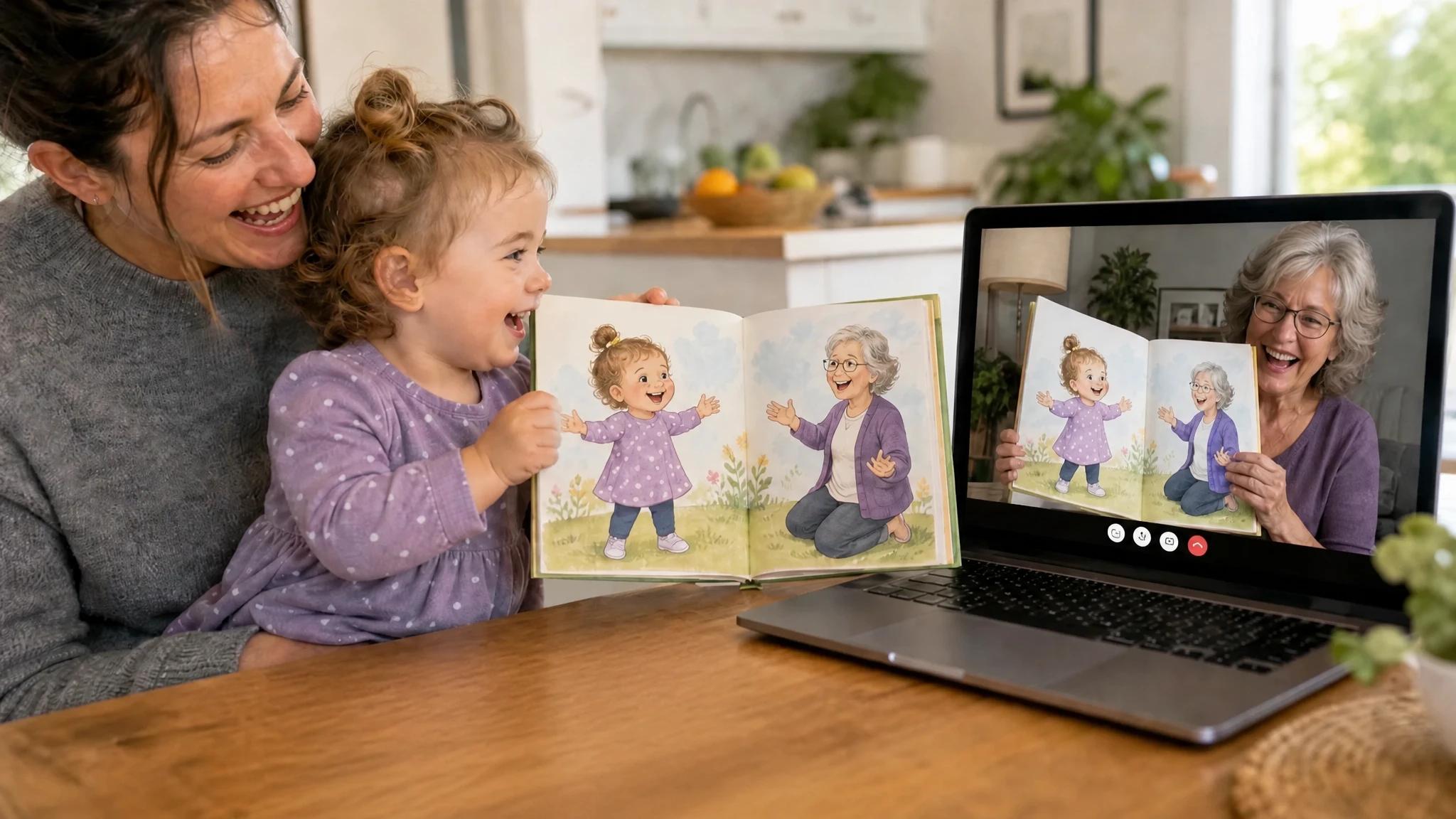
A toddler cannot hold a video call because there is nothing in it for their hands. The fix is not a longer call or a better script, it is a shared object on both ends: the same picture book open on Grandma's lap and on the child's, so the call has something to do. Ten minutes twice a week, with a book in the frame, does more than a monthly hour of "say hi to Grandpa".
Here is why it works, what it looks like at each age, and where the research stops and experience takes over.
What the research shows, and what it does not
Let us be honest about the evidence first. The study most often quoted about grandparents comes from the University of Oxford: a 2008 survey of 1,596 children aged 11 to 16, led by Professor Ann Buchanan, found that high grandparental involvement was linked to fewer emotional and behavioural problems, and that the link was strongest in separated families. The detail that matters for distance: only grandparents who "got stuck in", who actually did things with their grandchildren, showed this effect. Grandparents who merely felt close did not.
Notice the ages. That study is about teenagers, not toddlers. Nobody has run the equivalent for two-year-olds on video calls, so everything below about the under-fives is practical experience, not proven science. What Oxford does give you is the principle: involvement beats affection. Doing something together is the goal, and "together" has to be engineered from 500 miles away.
Why a two-year-old cannot hold a video call
Every long-distance grandparent knows the scene. The tablet is propped on the kitchen table, Grandma's face fills the screen, and the toddler looks for four seconds, says "hi", then walks off to play with a saucepan. Grandma keeps talking to an empty chair while a parent chases the child saying "come and talk to Nana".
This is not a sign the child does not care. A two-year-old's attention runs through their hands. A face on a screen gives them nothing to hold and nothing to point at, and conversation is a skill they will not have for years. Asking them to sit and chat is asking them to do the one thing they are worst at.
The fix is to stop making the call about talking and give it an object. The simplest one is a book.
The shared object: one book, two ends of the call
Grandma has a copy of a picture book. The child has the same copy. Grandma opens page one and holds it up to the camera; the parent opens the same page on the child's lap. Grandma reads, points, asks "where is the dog?", and the child points at their own copy. Turn the page together. Suddenly the call has a structure a toddler can follow: something to look at, something to touch, and a reason to stay.
Three things make this stick.
- The book has to be the same on both ends. Not "a book each". The child needs to see that Grandma's page matches theirs. That matching is the whole game.
- The child should be in the book if at all possible. A toddler who cannot yet hold a conversation can absolutely recognise their own face, and Grandma's. A book with the child as the hero and Grandma as a character gives the call a subject the child already cares about. A photo book of family faces does the same job for babies: "Where's Grandpa? There he is!"
- Keep the same book for weeks. Toddlers love repetition. The tenth reading is better than the first, because now the child knows what comes next and can shout it before Grandma turns the page.
The American Academy of Pediatrics' updated 2024 policy recommends shared reading beginning at birth, and notes that children who start young arrive at school associating books and reading with lap time, security, interaction and stories. A book on a call does not replace the lap, but it borrows the same feeling: a familiar adult, a familiar story, a shared page.
Short and frequent beats long and rare
Most advice also gets the schedule wrong. A Sunday hour is a big ask for a toddler and a big emotional event for a grandparent, which is exactly why it disappoints. Ten minutes, twice a week, is a better plan. Toddlers run on routine: if Tuesday bath time always ends with "Nana's book", the call stops being an interruption and becomes part of the day. Hang up while it is still going well. A call that ends with the child laughing is one they will want again; a call stretched until they wander off teaches them that calls are boring.
Between calls, the object keeps working. The book stays on the shelf, and every time the child picks it up, Grandma is in it.
What works at each age
| Age | What works on a call | What to send |
|---|---|---|
| Under 1 | Your face, your voice, singing. Babies respond to the sound, not the screen. Two to five minutes is plenty. | A photo book of family faces, and a recording of you singing or reading so the parent can play it at bedtime. |
| 1 to 2 | The same picture book on both ends. Point, name things, let them turn the page (or pretend to). Peekaboo behind the book. | The matching copy of the book. A small soft toy that "lives" at your house and visits on screen. |
| 3 to 5 | A story where they are the hero and you are a character. Ask them to "read" the pages they know by heart. Show them something real: your garden, your cat. | A personalized book with both of you in it. Postcards with one question they can answer on the next call. |
| 6 to 10 | Conversation starts to work. Read a chapter book together over several weeks. Draw the same thing or cook the same recipe on both ends. | Two copies of a chapter book. Letters they can answer. A project you both work on and compare. |
FAQ: questions long-distance grandparents ask
How often should I call a toddler?
Two or three short calls a week beat one long one. Aim for five to ten minutes at a fixed point in the routine (after breakfast, before bath) and stop while the child is still engaged. Frequency builds recognition; length does not.
What if the child ignores the screen?
That is normal, and it is not about you. Give the call an object: a book you both hold, a toy you both have, something to hunt for on the page. Sing rather than talk. And accept a call where the child plays nearby while you chat to the parent; they are still hearing your voice, and that counts.
What if the parents are too busy to set up calls?
Make it cheap for them. Fix a slot they do not have to think about, keep it short, and be the one who dials. Send things that work without a call at all: a voice recording for bedtime, a book that arrives in the post. The parents' job should be to prop up the tablet, not to run the show.
Which gifts actually keep the link alive?
The ones that carry your presence into the house between calls. A book with you in it, a recording of your voice, a photo book of family faces, a toy that "belongs" to you. Big toys are forgotten in a week; a book that gets read fifty times keeps working. For the December rush, a personalized book is the one Christmas gift for a grandchild that also gives you something to do on the next call.
Where Looma fits
We built Looma so a grandparent can be in the story, not just send it. A personalized children's book holds up to four characters, each illustrated from real photos, so the child sees Grandma's actual face on every page they hold. You read the whole book and can change any word before paying; the ebook is instant and the hardcover optional, so one copy can be at each end of the call. You can create one in a few minutes.