
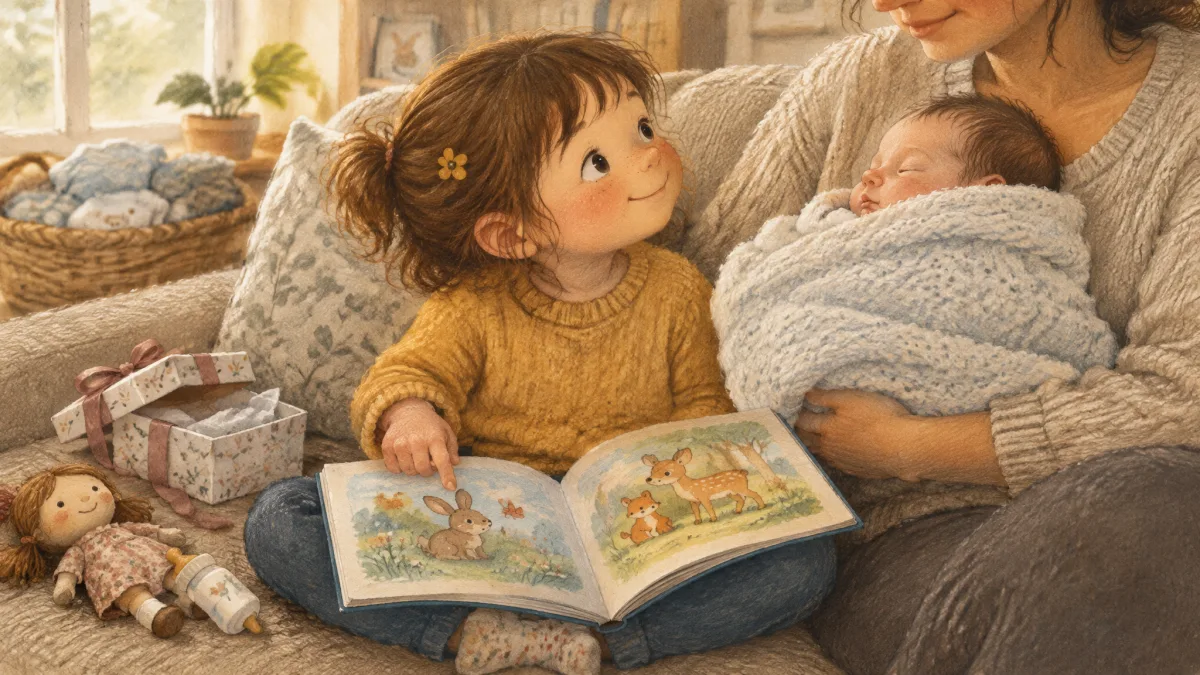
How to prepare your child for a new baby: when to tell them, what to say, and the books that help
To prepare a 2 to 6 year old for a new baby, tell them once the pregnancy becomes real to them, give them a marker they understand (a season rather than a number of months), and tell them the truth: the baby will be cute, but will also cry and take up a lot of your time. After the birth, expect some regression, protect a few minutes a day that belong only to them, and give them a role instead of a speech. Books help put words on what is happening, especially the ones where they recognize themselves.
Full disclosure up front: Looma Stories sells personalized books, and one of the books mentioned below is ours. Everything else in this guide is free, and the classic picture books we name do the job very well. This is the guide we wish we had read with a second baby on the way.
When to tell them, by age
There is no perfect date, only an age. Under 3, nine months is forever, so talk about the baby once things become visible: the growing bump, the crib going up. The American Academy of Pediatrics suggests using exactly those moments, for example when you start buying nursery furniture or baby clothes.
Between 3 and 5, they understand the idea but not the calendar. Nemours KidsHealth points out that "in a few months" means little to a preschooler, and that it works better to name a season: "the baby will come when it's cold outside." Their own landmarks work too: after your birthday, after Christmas.
From 6, they will notice everything, and hearing it from someone else is the worst way to find out. Tell them before the wider family and their school, and let them ask every question they have.
The words to use
Say "our baby" and "you're going to be a big brother" or "big sister": the role matters more than the baby. If you have picked a name, use it. Then be honest about what is coming. The AAP recommends explaining that the baby will be cute but will also cry and take a lot of your time and attention, and that it may be a while before they can play together. Promising a playmate sets up a letdown: a newborn sleeps, feeds and cries.
When "how did the baby get in your tummy?" arrives, let their questions guide the answer. KidsHealth notes that a 4-year-old asking where babies come from is not asking about sex, they want to know where, literally, the baby comes from: "the baby grows in the uterus, inside mom's belly" is often enough. And have a sentence ready for the hard days: "When the baby cries, I need to take care of the baby first. Then it's our time."
Involve them, without turning them into an assistant
- Getting ready: choosing a soft toy for the baby, folding the tiny clothes. The AAP suggests letting them shop with you for baby items.
- A baby of their own: a doll to feed and put to bed helps them understand what a baby is, an idea both the AAP and UNICEF recommend.
- Their own baby photos: NHS 111 Wales suggests telling them what they were like as a baby and getting out their old toys and photos.
- The birth plan: who will look after them, where they will sleep, when they can meet the baby. Tell them you will be back with the baby in a few days.
One planning point carries a lot of weight: big changes. The AAP and KidsHealth advise finishing potty training or the move from crib to bed well before the due date, or putting it off until the baby has settled in at home. A room switch happens a few weeks before, not the night before.
Regression: what it looks like, and why it is normal
A potty-trained child having accidents again, asking for a bottle, wanting to be carried or slipping into baby talk: that is the classic picture of the first weeks. The AAP puts it plainly: it is normal, and it is your older child's way of making sure they still have your love and attention. NHS 111 Wales calls it "completely normal behaviour" and says not to punish it.
What works, according to the same sources: give the attention they are asking for instead of "act your age", praise the moments when they act more grown-up, and keep the usual rules while looking for the feeling behind the behavior. And if none of this happens at your house, that is normal too. A 2012 review of 30 studies in Psychological Bulletin found that the evidence did not support the idea that a sibling's birth is a crisis for most children: depending on the family, it can be a bumpy time, a chance to grow, or a stretch with no noticeable change at all.
The first days at home
- The first meeting: KidsHealth suggests having your child visit the hospital as soon as possible after the birth, ideally when no other visitors are around. Have your arms free when they walk in.
- A real job: they can hold the baby as long as they ask first (that is the AAP's rule), pick the baby's outfit, sing during diaper changes.
- Feeds: this is often where jealousy peaks. Set up an activity before you start, or use the feed to read them a story, as NHS 111 Wales suggests.
- Their own time: ten to fifteen minutes a day with one parent and no baby, during a nap for instance. KidsHealth notes that knowing there is special time just for them can ease resentment.
- Their routines: daycare or school, the park, the bedtime story. They reassure more than any speech.
Visitors and the big sibling gift
Visitors come in, head straight for the baby, and the older child watches. Give them a heads-up: the AAP suggests asking family and friends to spend time with your older child when they come to see the baby, and notes that some may bring them a small gift along with the baby's. A "show me your room" before the "where's the little one?" changes the whole visit.
Many families add a tradition: the big brother or big sister gift "from the baby", waiting in the bassinet for the first meeting. The best one marks their new role rather than compensating: a doll with its own bottle, a big sister T-shirt, a book where they are the hero and the baby joins their story.
Age by age, at a glance
| Child's age | When to tell | What helps most |
|---|---|---|
| Under 2 | Once the bump and the preparations show | Simple words (baby, brother, sister), a doll, unchanged routines |
| 2 to 3 | Once it is visible, with a season as the marker | Potty training and the big bed handled before or after, a picture book read often, their baby photos |
| 4 to 5 | Once it is visible, before other kids at school know | Honest answers, a real job, daily time of their own |
| 6 and up | Early, before the wider family | A say in decisions (name ideas, the room), their activities kept going |
Books about becoming a big sister or brother
The AAP recommends reading books about newborns and siblings before the birth: they help children get familiar with words like sister, brother and new baby. Two kinds of books work well together.
The classic picture books about a new baby
For ages 2 to 4, Joanna Cole's I'm a Big Sister and I'm a Big Brother explain the new role in simple words, and There's Going to Be a Baby by John Burningham and Helen Oxenbury follows a little boy's questions through the seasons of the pregnancy. For ages 3 to 7, Ezra Jack Keats's Peter's Chair and Kevin Henkes's Julius, the Baby of the World dare to show real jealousy, which is exactly what makes them believable. These books explain what a baby is; they do not tell your child where they fit.
The book where your older child is the hero, and the baby joins the story
That is the other approach: a 36-page book, illustrated from a few real photos of your older child so the likeness holds page after page, in which they are the one who welcomes the baby. The baby comes in through the story itself: in the field where you write your own story idea (up to 800 characters), you describe the baby on the way and the place you want them to have, for example "Lea, 4, gets the house ready for Little Bean, and the story ends with her welcoming her baby brother home." No need to wait for the birth or to have picked a name: the bump nickname works fine. You can also start from the "New Baby Sister" or "New Baby Brother" theme. Mom, dad or grandma can become characters from their photos: the hero plus up to four other characters.
How it works, plainly: the ebook is paid when you order (€3.99) and is ready in about two hours. You then read the whole book, edit every sentence and have any picture redrawn, before the final version. The hardcover is optional, €24.99 on top, with delivery priced at checkout, printed and delivered in 8 to 14 working days in the EU. For the UK, the delivery estimate is shown at checkout. If you want it waiting in the bassinet on meeting day, order it during the third trimester.
FAQ: what parents ask
When should I tell my 2-year-old about the new baby?
Once it becomes visible to them: the growing bump, the nursery taking shape. Talk about it in small doses with simple words, and read a picture book about babies often.
Is it normal for my toddler to act like a baby again after the birth?
Yes. Accidents after potty training, wanting a bottle, needing to be carried: pediatric guides (AAP, NHS 111 Wales, UNICEF) all describe this kind of regression as common. Respond with attention rather than punishment, and praise the moments they act grown-up. If it lasts for months or worries you, talk to your pediatrician.
Should the baby give the older sibling a gift?
Nothing requires it, but many families do it, and the AAP recommends giving your older child a special gift after the birth. Pick something that speaks to their new role rather than a big toy: a doll with its own bottle, a book about big brothers and sisters, or a book where they are the hero.
Can I make a personalized book before the baby is born?
Yes. The hero is illustrated from their photos, and the baby enters the book through the story idea you write: a few lines describing the baby and how your older child welcomes them, with the bump nickname if the name is not chosen yet. The baby is not a character drawn from a photo, they are part of the story.
Where Looma fits
If you take one thing away: a well-prepared older child is not one who got a nice speech, it is one who has a role. Classic picture books explain what a baby is; a book where they are the hero shows them their place. If that idea speaks to you, our personalized new baby book can become the big brother or big sister gift, with the baby in the story. You can create one in a few minutes for the price of the ebook, then read the whole book before deciding whether the hardcover is worth it.