
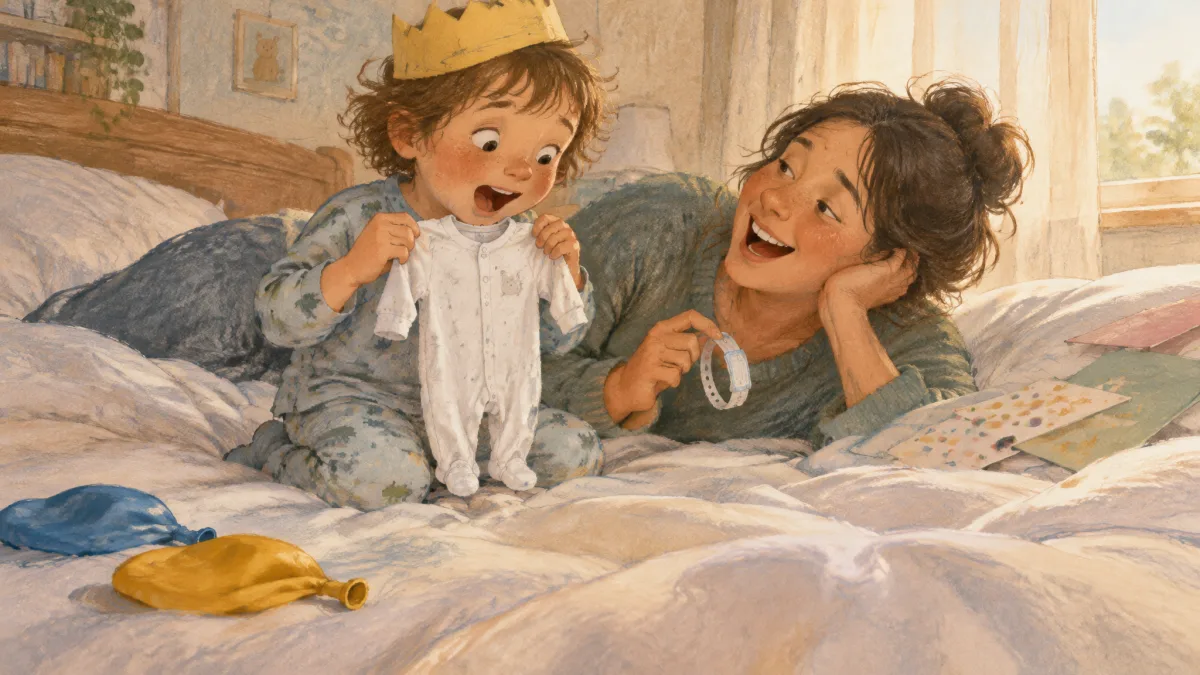
How to tell your child the story of the day they were born (and why it is worth repeating every birthday)
To tell your child their birth story, keep it short, true and told from their side: who was waiting for them, what the day was like, and how it felt the first time you held them. Add detail as they grow (the weather at two, the funny moments at four, the real timeline at seven) and tell it at the same moment each year, ideally as the opening of their birthday. It is the one story every family already owns, and nobody else can tell it.
Most "birth story" guides online are for the mother: how to write it down and process it. This one is about telling the story to the child, out loud, at an age when it lands, and making it something they ask for every year.
Why a story you already know by heart matters more than it looks
In a long-running study from the University of Otago, 115 mothers of toddlers were coached in "elaborative reminiscing", meaning open, responsive conversations about everyday past events. Fourteen years later, their fifteen-year-olds told more coherent stories about the turning points in their lives and reported fewer symptoms of anxiety and depression than the teenagers whose mothers had not been coached.
One honest caveat: those mothers were coached on everyday events, a trip to the park, a visit to Grandma, not on birth stories specifically. So this is not a magic bullet. It is simply the easiest place to start the habit, because you already know this story by heart, your child is the hero of it, and they will ask for it again.
The American Academy of Pediatrics' updated 2024 policy recommends shared reading from birth, noting that children who start young arrive at school associating books and reading with lap time, security, interaction and stories. A birth story told on your lap is the same recipe with the book taken away: a voice, a story, and your child at the centre of it.
What to include, and what to leave out
The version for your child is not the full version. Choose the parts that belong to them.
- Who was waiting. Grandparents by the phone, a big sister at a neighbour's house, a dog that would not settle.
- What the day was like. Rain, heat, snow, a traffic jam, a doctor with a funny name.
- The first moment. The first thing you said, who held them first, what they did (cried, stared, sneezed, slept through it all).
- The name. Why you chose it, who suggested it, what it nearly was.
- The first visitors. Who came, what they brought, what the sibling said.
Leave out the medical detail, the fear, and anything that could make a child feel they caused pain or trouble. "You were a difficult birth" is a sentence for your partner or your journal, not for a four-year-old. You are not hiding the truth; you are choosing which truths are theirs to carry at this age.
The story at 2, 4 and 7
The story does not change. What your child can hold does. Here is a rough guide.
| Age | What they want | What to say | How long |
|---|---|---|---|
| Around 2 | Their own name, repetition, the same words every time | "The day you were born it was raining, Dad drove very fast, and you had lots of black hair." | Three or four sentences |
| Around 4 | The funny parts and the cast of characters | Who came, what Grandma said, what your brother did, how you got your name | A couple of minutes, with room for questions |
| Around 7 | The real timeline and their place in it | What time it was, where, what happened in what order, what you were thinking, honest answers | A proper story with a beginning, a middle and an end |
Around two
Toddlers want the same story with the same words, and they want their name in it. Keep it to a few sentences and do not vary them. By the third telling, pause before the last word and let them finish it.
Around four
Four-year-olds want to laugh and they want to know who was there. This is the age for the cast: the grandparent who got lost in the car park, the sibling who asked if the baby could go back. "Was I loud?" deserves a real answer.
Around seven
By seven, children want the true order of events and how you felt inside. They will notice if a detail changes from last year. This is also the age when they start telling the story back to you, sometimes to a younger sibling, which is exactly the point.
How to make it the opening ritual of every birthday
- Pick a fixed moment. At breakfast before the presents, or at bedtime the night before. The same slot each year is what turns a story into a ritual.
- Use the same opening line. "Seven years ago today, at this exact time..."
- Add one new detail a year. Keep a note on your phone. The story grows with them.
- Let them take over. From five or six, they will correct you and fill in pieces. Let them. They are building the story, not just hearing it.
- Bring in the cast. A grandparent on the phone who tells their side, a sibling who was there. Different voices make it a family story rather than a parent's speech.
FAQ: questions parents ask
When should I start telling my child their birth story?
Around two, when children start talking about "yesterday" and want to hear about themselves. Earlier does no harm; they will not remember it, but you will have found your words by the time they do.
What if the birth was hard?
You do not owe your child the hard version. Tell the part that is theirs and true: they arrived, they were wanted, someone held them. The rest can wait until they are old enough to ask, and you decide when that is. If the memory is still painful for you, it is fine to keep the story very short for a few years.
What if my child was adopted?
The day they were born is still their day, even if you were not there. Tell what you know, honestly, and treat the day you met as a second chapter with its own details. "We do not know everything about that day, but here is what we do know" is a good sentence for a child to hear.
Does a C-section count?
Yes. It is a birth, with a date, a first cry and a first cuddle like any other. For a toddler, "the doctors helped you out through a special door" is honest enough. Around seven you can be more precise; they will mostly want to know the same things as any child: who was there and what you said.
What about twins?
Tell it as one story with two heroes, and give each child a detail that belongs only to them: who came first, who cried first, who had more hair, who the nurse called "the quiet one". Twins share a birthday; they should not have to share a story.
Turning it into something they can hold
Some families write the story down; some build a photo book from that first week. On Looma you can also tell "the day you were born" as an illustrated book where your child is drawn from their real photos as the hero, and parents, grandparents and siblings appear alongside them (up to four characters), then give it again each year as the birthday opens. You can create it in a few minutes for the price of the eBook, then read the whole book and change any word before the final version. But the book is optional. The telling is what matters, and you can start tonight.