Can you make a personalized children's book with ChatGPT, Gemini or Claude? An honest comparison from a company that uses AI
Yes, you can make a personalized children's book with ChatGPT, Gemini or Claude, and for a one-night story all three work. Type your child's name, their dog, their fear of the dark, and you will have something to read from your phone in two minutes; Gemini will even illustrate it as a ten-page storybook. The limits show up when you want pictures that look like your child on every page, text that survives a fortieth reading, and a printed book. For those, the research on print versus screens and the way image generators handle faces both matter, and this article walks through them plainly.
We should say up front: Looma Stories uses AI to write and illustrate its books. So this is not a "robots are ruining childhood" piece. It is the comparison we would want if we were the parent.
What an AI chat does well tonight
If your child is asking for "a story about me and Biscuit the dog on the moon" at 7:45 pm, any of the three is a genuinely good answer. It is free, it is fast, and a story with their name and their dog in it will delight a three-year-old more than most of the books on the shelf. A prompt that works in all three:
- Give the age, the name, and three real details (the pet, a favourite food, something they are a little scared of).
- Ask for a story under 400 words with a clear beginning, a small problem, and a warm ending.
- Say what you want the story to be about underneath: sharing, being brave, missing Grandpa.
- Ask it to avoid explaining the moral at the end. It will do it anyway. Delete that paragraph.
Read it aloud from your phone, change the bits that sound wrong, and enjoy it. Nobody needs a hardcover for a Tuesday.
ChatGPT, Gemini or Claude: what each one actually does
The three get lumped together, but for a children's book they do quite different jobs. Here is what each one gives a parent today, free accounts included.
ChatGPT: the story, and pictures one at a time
ChatGPT writes the story and can draw pictures, even on a free account, where the image allowance is a few a day and moves with demand. Each picture is its own request, so a book means asking page by page and steering the hero back to the same look every time. You can upload a photo for it to work from, one picture at a time.
Gemini: a ten-page illustrated storybook
Gemini has a feature made for this, called Storybook. Describe the story and it returns a ten-page book with illustrations and read-aloud narration, in more than 45 languages and in styles from comics to claymation. You can add your own photos, which Google describes as inspiration for the story and the pictures, then share the result by link or print it from your browser. Two limits worth knowing: you change the text by asking Gemini to rewrite it rather than editing it yourself, and the feature is for users aged 18 and over, so it is a parent's tool, not one to hand to the child.
Claude: the words, not the pictures
Claude writes stories in the chat and you can redraft them as often as you like, but it does not draw. Anthropic's own help page says Claude doesn't generate photos or illustrations. It can lay the text out as a page, which works well if your child illustrates the book themselves, or if you pair it with an image tool.
Where it falls apart
We know these limits because we hit every one of them while building Looma. They are not reasons to avoid AI; they are the parts a service has to solve on top of the chat tools, and the parts you cannot solve alone at the kitchen table.
The hero does not keep their face
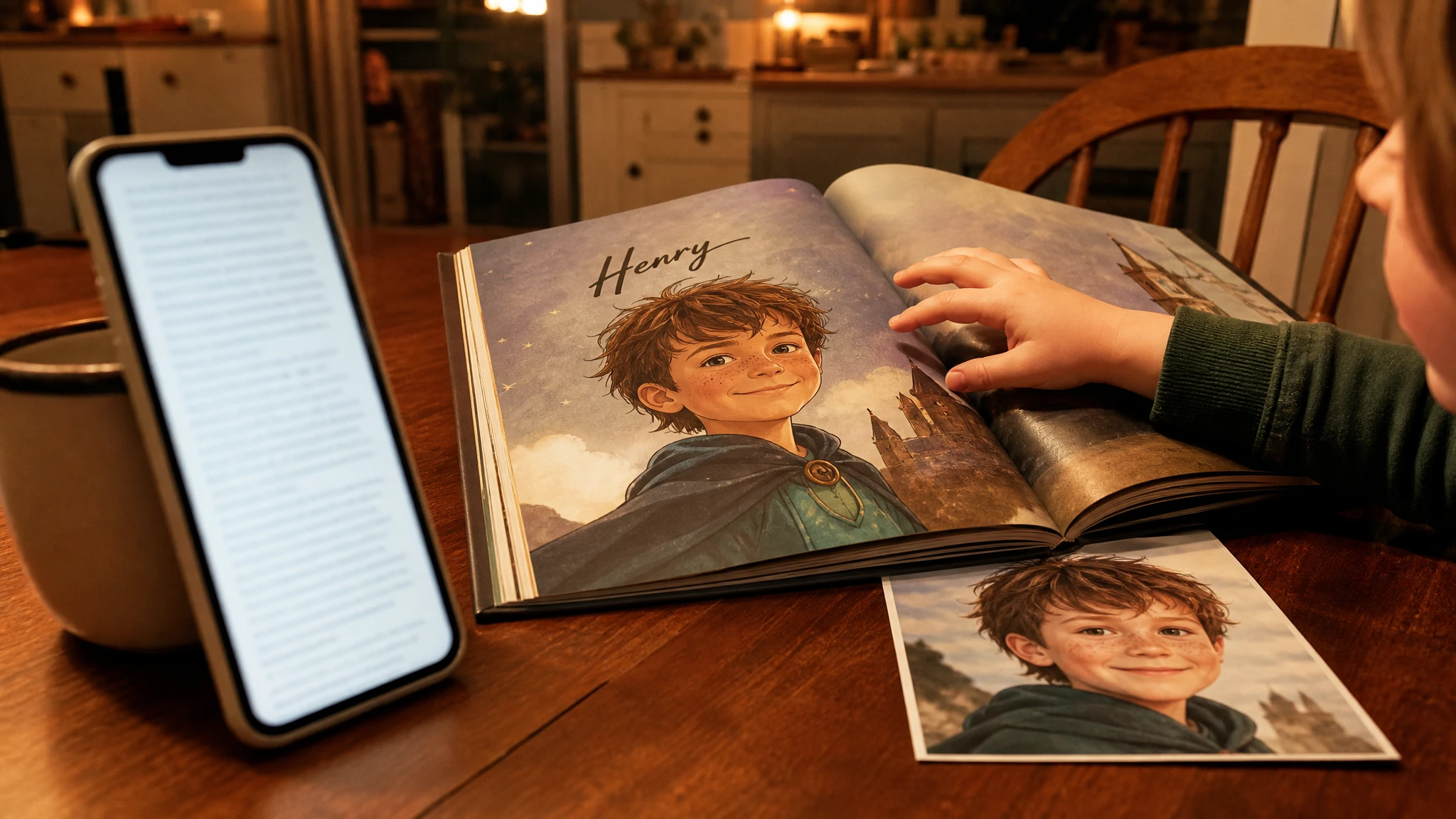
Ask an image generator for "a five-year-old girl with curly hair and red boots" fifteen times and you get fifteen different girls. Consistency of a character across pages is the hardest problem in illustrated books, and it is much harder still when the character has to look like your child. Doing that properly means starting from real photos and checking the likeness on every single page. A chat window does not do that for you, and a storybook that treats your photos as inspiration does not promise it either.
The prose is fine, and fine is the problem
First-draft AI writing for children has a recognisable sound: every sentence the same length, feelings named rather than shown, a lesson spelled out in the last line. It reads well once. On the tenth reading, the child is bored and so are you. Good children's books earn re-reading through rhythm, a repeated line the child can shout, and a page-turn that makes them want the next one. That takes editing, and it takes rules for age: a book for a two-year-old and a book for a seven-year-old are different objects.
From a chat to a real book
ChatGPT and Claude give you text, and ChatGPT adds pictures one by one. Turning that into a book means illustrating it, laying it out with bleed and gutters, checking the text does not fall into the spine, and getting it printed and bound. You can do this yourself through a photo-book service, and some parents do. Budget an evening or two and expect to land at roughly the price of a ready-made personalized book anyway. Gemini's Storybook gets you closer: ten illustrated pages you can share or print at home. What it does not give you is a bound hardcover, a hero drawn to match your child, or the words exactly as you want them without another round of asking.
Free AI story versus a printed personalized book
| What you get | ChatGPT, Gemini or Claude, on your own | A service built for it (Looma as the example) |
|---|---|---|
| Cost | Free for text; a few images a day on ChatGPT's free plan; Storybook included in the Gemini app | €3.99 for the ebook; hardcover €24.99, delivery calculated at checkout |
| Time | Two minutes for a story; an evening or two for a printed book | About ten minutes, including editing |
| Pictures | ChatGPT one at a time; Gemini ten pages; Claude none | Every page illustrated |
| Hero likeness | Described in words, or a photo used as a starting point | Illustrated from your child's real photos |
| Same face on every page | Not reliably | Checked page by page before you see it |
| Editing the text | Yes in ChatGPT and Claude; by asking for a rewrite in Gemini | Every word, and any picture redrawn, once the ebook is paid |
| More than one child | In the text, yes; in the pictures, hard to keep consistent | The hero plus up to four other characters, siblings and grandparents included |
| Printed hardcover | Your own layout plus a print shop, or a home print of a Gemini storybook | Optional, printed and shipped for you |
| Best for | Tonight's story | A gift, a keepsake, a book they will ask for again |
The part that is not about AI at all: the object in their hands
Whichever way you make the story, there is a separate question about how your child meets it. In a University of Michigan study of 37 parent-toddler pairs, families reading on a tablet talked less and had lower-quality interactions than the same families reading print books; the researchers describe parents spending their words on the device ("don't push that") instead of on the story. The study compared print with tablets, not humans with AI, so treat it as a finding about the medium, not the author. It still points the same way: a story you can hold, point at and go back to does something a phone screen does not.
The American Academy of Pediatrics makes the wider case in its updated 2024 guidance: shared reading should start at birth, and children who start young arrive at school associating books with lap time, security and stories. A book they are in, that they can carry to bed, fits that picture rather better than a chat window.
How we use AI, in plain words
Since we are asking you to trust a comparison written by a vendor, here is the plain version. Yes, AI writes and illustrates Looma books; that is why an ebook costs a few euros and not forty. What you get on top is our own work: the story is built around your child and your details, the illustrations start from your photos and the likeness is checked on every page, and the tone and length follow your child's age. How we do that is our kitchen, and we keep it to ourselves. What you can judge is the result: you pay for the ebook up front, then read the whole book, change any word and have any picture redrawn before the final version, and the hardcover is only printed once you are happy.
So, which one?
- A story for tonight, a silly request, a long car ride: ChatGPT, Gemini or Claude. Do not overthink it.
- A quick illustrated story to share with the family: Gemini's Storybook, the do-it-yourself route that gets closest to a picture book.
- A gift from a grandparent, a birthday, Christmas: a printed book with the child's real face on the cover. The child will not read the prompt; they will hold the book.
- A child who is starting to turn away from reading: either can help, because the hook is being in the story. If it works, move to print so the book can live on the shelf.
- Siblings who fight over who the hero is: a book with both of them in the pictures, which is the case where DIY struggles most.
FAQ: questions parents ask
Is it safe to put my child's name and photo into ChatGPT, Gemini or Claude?
A first name and a dog's name are fine. Photos are a different matter: check what the tool does with uploaded images before you send any, and prefer services that say clearly what they keep. Our own rule is that photos are used to illustrate your book and nothing else.
Can these tools make the illustrations too?
ChatGPT and Gemini can, and some of the pictures are lovely; Claude does not draw. What none of them promises is to keep the same child, in the same style, across a whole book, or to make that child look like yours without photos and a consistency check on top.
Is Gemini's Storybook enough for a gift?
It can be, for a story shared by link or printed at home. It gives you ten illustrated pages with narration from a short description, and it uses your photos as inspiration. Where it stops is where a gift usually starts: a hero who looks like your child on every page, words you can edit directly, and a bound hardcover to wrap.
Can I print an AI story myself?
Yes. Paste the text and your images into a photo-book editor, lay out the pages, order a hardcover; a Gemini storybook can also be printed from your browser. It works; it just costs an evening and lands near the price of a ready-made book.
Are AI children's books just bad?
Many are, honestly, because they stop at the first draft. Judge the book, not the tool: read the whole book, check the hero's face across several pages, and see whether the text has any rhythm. That test is fair to everyone, ourselves included.
Where Looma fits
If you take one thing from this: the tool is not the point, the result is. Use ChatGPT, Gemini or Claude freely for tonight. When you want a book your child recognises themselves in and asks for again, that is what our personalized children's book is built for: an illustrated likeness from real photos, held consistent page to page, the hero plus up to four other characters, and every word editable once the ebook is paid. You can create one in a few minutes for €3.99, then change any sentence and redraw any picture until it feels like theirs.