
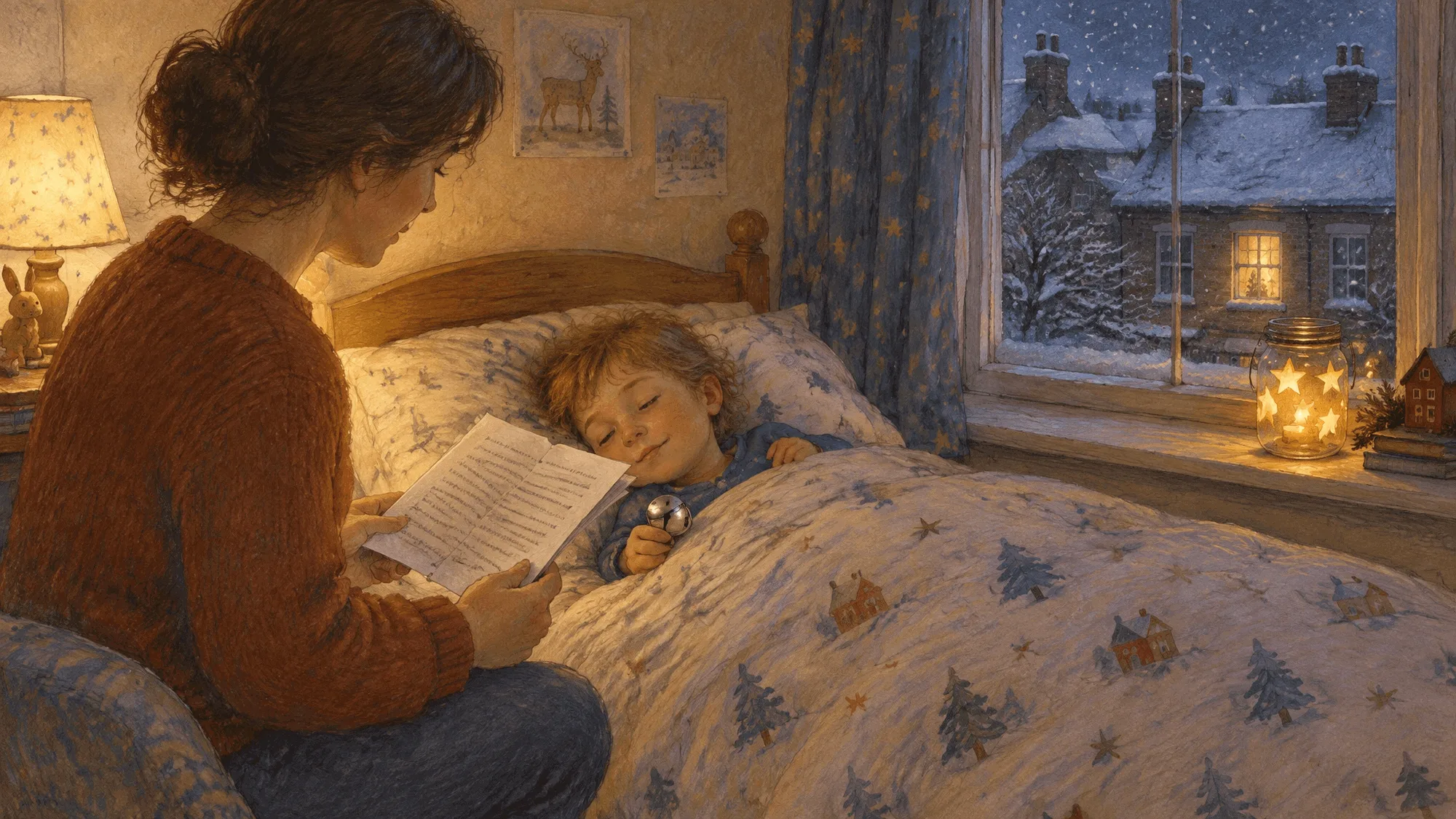
Short Christmas stories for kids to read aloud (2026): 4 complete stories, about 5 minutes each
Here are four short Christmas stories for kids, complete and ready to read aloud tonight: one for ages 3 to 5 that takes about 4 minutes, and three for ages 4 to 8 that take 5 to 6 minutes each. Each comes with its reading age, its time at a calm bedtime pace and one line on why it settles a child rather than winding them up. We wrote all four for this page, so you will not find them in another book.
You are welcome to read them aloud, print them for your family or read them to a class. Looma Stories sells personalized books, and the last section shows how to make your own child the hero of a Christmas story, with a pen or with us. The stories themselves come first.
The four stories at a glance
| Story | Ages | Time aloud | What happens | Best for |
|---|---|---|---|---|
| 1. The bell that lost its jingle | 3 to 5 | about 4 minutes | The smallest sleigh bell goes looking for its sound | Toddlers who love a repeated line |
| 2. The snowman who wanted to see Christmas | 4 to 7 | about 5 minutes | A boy and his grandmother keep a promise to a snowman | A child who finds endings hard |
| 3. Tinsel, the elf who wrapped everything | 5 to 8 | about 6 minutes | The clumsiest elf in the workshop saves Christmas Eve | A giggle before lights out |
| 4. A light in Mr Hollis's window | 5 to 8 | about 5 minutes | A girl makes a lantern for the neighbour who lives alone | Children a little afraid of the dark |
Times are our own measure at a slow read-aloud pace of about 120 words a minute, with pauses for the pictures in your child's head. Read faster and they shrink; stop to answer questions and they grow.
1. The bell that lost its jingle
Ages 3 to 5, about 4 minutes. Why it works at bedtime: the same little question comes back three times, so your child can say it with you, and the story ends in a dark, sleeping house.
Up at the North Pole, on the night before Christmas Eve, Father Christmas was checking his sleigh. He shook the reins, and all the bells went jingle, jingle, jingle.
All except one.
The smallest bell, right at the very end, went tk. Just tk. Like a pebble in a shoe.
"Oh dear," said the smallest bell, whose name was Ting. "I've lost my jingle."
"Then you had better go and find it," said the oldest reindeer kindly. "We leave tomorrow night."
So Ting rolled off the sleigh, plop, into the snow, and away into the dark forest.
Ting met an owl on a branch. "Owl, have you seen my jingle?"
"Hoo, hoo," said the owl. "That's not a jingle. That's my hoo. I need it to say goodnight to the moon."
"Thank you anyway," said Ting, and rolled on. Tk, tk, tk.
Ting met a little stream, gurgling under the ice. "Stream, have you seen my jingle?"
"Glug, glug," said the stream. "That's not a jingle. That's my glug. I need it to sing to the fish."
"Thank you anyway," said Ting, and rolled on. Tk, tk, tk.
Ting came to a village, where the big bell in the church tower was getting ready for bed. "Big Bell, have you seen my jingle?"
"Dong," said the big bell, very slowly. "That's not a jingle. That's my dong. I need it to tell the village it's bedtime. But I know a secret. Every bell in the world gets its sound from the same place."
"Where?" asked Ting.
But the big bell had already fallen asleep. Doooong.
Ting was very tired now. Ting rolled down a little street, through a little gate, up to a little door, and into a little red slipper waiting on the doormat. It was warm in there. Ting fell asleep.
In the morning, the door opened, and there was Lily, in her pyjamas, with very messy hair. "What's this?" She picked up her slipper and shook it, and out fell Ting. Tk.
Lily shook Ting gently. Tk. She shook Ting a little harder. Tk, tk.
It was such a funny sound, like a mouse sneezing, that Lily began to laugh. She laughed and laughed until her messy hair bounced.
And all of a sudden: jingle!
Ting rang so clearly that the cat woke up on the radiator. That was the big bell's secret. Every bell gets its sound from a child laughing.
That night, on Christmas Eve, Lily put Ting on her windowsill, close to the glass. "So you can go home," she whispered. Then she climbed into bed and closed her eyes.
At midnight, a sleigh flew over the rooftops, and all its bells went jingle, jingle, jingle. The smallest one, right at the very end, rang loudest of all.
Lily didn't hear it. She was fast asleep, with a smile on her face. And in the morning, all that was left on the windowsill was a tiny sprinkle of silver glitter.
2. The snowman who wanted to see Christmas
Ages 4 to 7, about 5 minutes. Why it works at bedtime: a child solves a worry with small, practical steps, and the ending is gentle about things that do not last, closing on a tin that waits on a shelf for next winter.
Five days before Christmas, Leo woke up at Nana's house in the hills, and the whole world had gone quiet. Snow. Real snow, deep enough to swallow his wellies.
After breakfast, Leo and Nana built a snowman by the garden gate. Leo rolled the body, Nana rolled the head, and together they lifted it on with a grunt. Two big black buttons from Nana's sewing tin made the eyes, a carrot made the nose, and Nana's old green scarf went round his neck.
"What shall we call him?" said Nana.
Leo looked at the buttons. "Mr Button," he said.
That night, Leo could not sleep. He pressed his nose to the bedroom window. Mr Button stood in the moonlight, very still and very white. And Leo was almost sure he heard a small, snowy voice.
"Leo? Will I still be here for Christmas?"
Leo thought about it. Christmas was five whole days away, and snowmen do not usually last that long.
"I'll make sure you are," he whispered. "Promise."
The next morning the sky was blue and the sun was bright, which is lovely for everybody except snowmen. Mr Button's carrot had begun to droop. Leo ran to the hall and came back with Grandad's big black umbrella. He planted it in the snow so that Mr Button stood in its shade.
"Clever boy," said Nana.
On the third day, Mr Button had shrunk a little. Leo took his bucket to the bottom of the garden, under the hedge, where the sun stayed away all day and the snow was still deep and crunchy. He patted fresh snow onto Mr Button's tummy, his shoulders and his cheeks until he was round again.
On the fourth day, Amira and Sam from next door came out to see what Leo was doing. When they heard about the promise, they fetched their buckets too. Soon five children were carrying snow from every shady corner of the lane, and Mr Patel from the farm came over with a big garden parasol. "For the cause," he said, and put it up next to the umbrella.
On Christmas Eve, Mr Button was smaller than Leo. He leaned a little to one side, like someone very tired who is trying to stay up for something important. Before bed, Leo put his coat on over his pyjamas, and Nana let him go out to the gate for one minute. He tied a little silver bell to Mr Button's scarf.
"Only one more sleep," he said. "Hold on."
On Christmas morning, Leo did not run to his stocking first. He ran to the window.
Mr Button was still there. Small and lumpy, his carrot pointing at the ground, but there, with his two button eyes looking straight at the house and the little bell shining on his scarf.
Leo went out in his slippers and told him everything: the tangerine at the bottom of the stocking, the cracker that went bang, the paper crown that was too big for him. "You saw Christmas," he said. "You did it."
Two days later, it rained. When Leo went outside, there was only a puddle, a carrot, an old green scarf, a little bell and two black buttons.
Leo felt his throat go tight. Nana crouched down beside him.
"Snow always comes back," she said. "Every winter. It just needs somewhere to wait."
So Leo put the buttons, the bell and the scarf in Nana's old biscuit tin, and on the lid, in big letters, he wrote: MR BUTTON. NEXT WINTER.
And the tin is still there, on the top shelf of Nana's cupboard, waiting for the snow.
3. Tinsel, the elf who wrapped everything
Ages 5 to 8, about 6 minutes. Why it works at bedtime: children laugh at the list of silly parcels and guess what comes next, the elf's odd talent turns out to be exactly what is needed, and the last line tucks her into bed like a present.
At the North Pole, in the workshop where the Christmas presents are made, there is a room that smells of paper and glue. It is the wrapping room. And in the wrapping room, the newest elf was called Tinsel.
Tinsel loved wrapping. She loved the crackle of the paper, the zzzip of the sticky tape, and most of all the moment when you pull a ribbon tight and make a bow so perfect it looks like a butterfly.
The trouble was, Tinsel did not only wrap presents.
On Monday she wrapped the teapot. Nobody could pour the tea.
On Tuesday she wrapped the head elf's chair while he was standing up. When he sat down, it crackled so loudly that he jumped back up and spilled his cocoa.
On Wednesday she tied tartan ribbons on the antlers of all eight reindeer. The reindeer actually liked that.
On Thursday she wrapped a snowball as a present for the cook. By the time the cook opened it, it was a soggy parcel of water.
And on Friday she wrapped the workshop cat. The cat did not like that at all.
"Tinsel!" said the head elf, whose name was Mr Pinecone and who had a very long beard and very little patience. "Presents only! From now on, you can sort the letters instead."
So Tinsel sat in the letter room and sorted letters into piles, from A to Z, and she did not touch a single roll of paper. She felt like a bow without a present.
Then came Christmas Eve.
The sleigh was ready. The reindeer were stamping their hooves. The sack, the enormous red sack with every present inside, was being lifted on board when... RRRRIP.
The old sack split from top to bottom, and thousands of presents tumbled into the snow.
"Sew it up!" shouted Mr Pinecone.
"No time," said Father Christmas, looking at his watch. "We leave in ten minutes, or some children will wake up to an empty stocking."
Everyone ran about. Some elves picked up presents and dropped them again. Two elves bumped heads. The cat hid under the sleigh.
Tinsel ran too, but she did not run about. She ran straight to the wrapping room.
She came back pulling the biggest roll of paper at the North Pole, the one with gold stars on it, and the longest ribbon ever made, so long that nobody had ever found the end.
"Stack them up!" she called. "Big ones at the bottom, small ones on top!"
The elves stacked. Tinsel unrolled. Round and round she went with the paper, zzzip, zzzip went the tape, and round and round she went with the ribbon, tighter and tighter, until every present in the world was inside one gigantic parcel as tall as a house.
On top, she tied the biggest, most perfect bow anyone had ever seen. It looked like a butterfly the size of a reindeer. Then she tied the end of the ribbon to the back of the sleigh. Double knot.
Father Christmas walked all the way round the parcel. He tugged at the ribbon. It held.
"Tinsel," he said, "in three hundred years, that is the finest wrapping I have ever seen."
And the sleigh rose into the sky with the giant parcel swinging behind it like a kite, and not one single present fell out all night.
The next morning, when the sleigh came home, Father Christmas gave Tinsel a present of her own. It was wrapped very badly. The paper was crumpled, there was tape everywhere, and the bow was more of a knot.
"I did it myself," said Father Christmas, a little embarrassed.
Tinsel laughed so much that she had to sit down. Inside was a small golden badge that said: HEAD OF WRAPPING.
That night, Tinsel went to bed and pulled her blanket all the way round her, tucked in at the sides and folded neatly at the top, like the best present she had ever wrapped.
And then she fell asleep.
4. A light in Mr Hollis's window
Ages 5 to 8, about 5 minutes. Why it works at bedtime: the whole story moves toward one small light in a dark window, which is a calming picture to fall asleep on, and the kindness in it is shown rather than explained.
Every December, the houses on Nina's street lit up one by one. First the Okafors' house with its blue lights, then the flat above the bakery with its paper star, then Nina's own house, where Dad always got the fairy lights in a tangle and muttered words he was not supposed to say.
By the middle of December, every window was glowing. Every window except one.
Number 7 stayed dark. That was where Mr Hollis lived. He was very old and walked with a stick, and every morning he waved to Nina from his window as she walked to school. But at night his window stayed black, like a missing tooth in a smile.
"Why doesn't Mr Hollis put up any lights?" Nina asked at dinner.
Mum thought for a moment. "His family lives a long way away," she said. "And since his wife died, I think Christmas feels a bit big for one person."
Nina did not say anything. But after dinner, she went to the recycling box and took out a clean jam jar.
She spent three evenings on it. She cut stars out of yellow tissue paper and glued them all around the glass. She tied a string handle round the top. Dad gave her a little battery candle, the kind that flickers but stays cool, to put inside. Then she drew a card: a house with one bright window, and underneath, in her best writing, For Mr Hollis, from Nina at number 4. Happy Christmas.
On the evening of the 23rd, with Mum waiting at the gate, Nina tiptoed up the path of number 7. She switched on the candle, set the lantern on the doorstep, rang the bell and ran.
From behind the hedge, they watched the door open. Mr Hollis bent down slowly. He picked up the lantern and held it close to his face, and for a long time he did not move at all. Then he went inside and closed the door.
"Maybe he didn't like it," whispered Nina.
"Let's wait and see," said Mum.
The next evening was Christmas Eve. When Nina looked out of her bedroom window, she gasped. In the window of number 7, a little light was glowing. Yellow stars, flickering.
Then there was a knock at the front door. It was Mr Hollis, in his best coat and scarf, holding a tin.
"Mince pies," he said. "My wife's recipe. I haven't made them for three years. I thought perhaps someone at number 4 might like some."
Dad opened the door wide. "Come in, Mr Hollis. We have far too much food and nobody to tell us old stories."
So Mr Hollis came in. He ate dinner with them, and his mince pies were the best Nina had ever tasted. He told them about the Christmas when he was a boy, when the snow came up to the windows and his father pulled the turkey home on a sledge. Nina laughed so hard she got hiccups.
When it was time to go, Nina walked him back to his gate, holding his hand. All along the street the windows were glowing, and now there was no gap at all.
"Thank you for the light, Nina," said Mr Hollis.
"You can keep it," said Nina. "For every Christmas."
And he did. Every December after that, the first window to light up on Nina's street was the one at number 7.
How to read them so they work at bedtime
- Read the story to yourself once first. Two minutes is enough to spot the line you will want to slow down on.
- Let them say the refrain. In story 1, stop before "Owl, have you seen my jingle?" the second time. Three-year-olds love finishing it.
- Lower your voice toward the end. All four stories finish quietly on purpose. Read the last paragraph slower and softer than the first.
- One story a night is plenty. Four stories make four evenings, and children often ask for the same one again. Repetition is part of the pleasure at this age.
- Make the lantern from story 4 together. A clean jar, tissue paper, glue and a battery tealight. It turns the story into an afternoon, and maybe a neighbour's evening.
Make your child the hero of the next one
Children listen to these stories differently once they have heard one where they are the one who finds the bell or saves Christmas Eve. You can write that story yourself in an evening: our guide on how to write a Christmas story starring your child has a six-step fill-in template and ten plots by age, and any story above can be its skeleton (your child as Lily with the bell, or as Nina with the lantern).
If you would rather have it written and illustrated for you, our personalized Christmas story does that from your child's photos, with up to four other characters alongside them (a grandparent, a sibling, the dog), each drawn from a photo too. Once the 3.99 € ebook is paid, it is ready within a few hours, and you read the whole book, change any sentence and have any picture redrawn before the final version. The hardcover is 24.99 € more, plus delivery priced at checkout, and has a Christmas order-by date per country on that page. Looking for a present for under the tree? See our Christmas gift book for kids, or start your child's story now.
FAQ: what parents ask
Can I print these stories or read them to a class?
Yes. We wrote them for families and teachers to read aloud, so print them, read them at school or at the library, and change the names if you like. Please link back to this page if you share them online.
How long should a Christmas bedtime story be?
For ages 3 to 5, about 300 to 500 words, or 3 to 4 minutes aloud. For ages 5 to 8, 500 to 800 words, or 5 to 7 minutes. Past that, split it over two evenings.
Which story is best for a 3-year-old?
Story 1, the bell that lost its jingle. It is the shortest, the sentences are simple and the question that repeats lets a three-year-old join in. Story 2 works from about four.
Can I swap in my child's name?
Yes, and it works best if you add one real detail as well: their own slippers in story 1, their grandmother's garden in story 2, your street in story 4. A real detail makes the story theirs far more than a name does.
Do the stories need Father Christmas?
Stories 1 and 3 have him; stories 2 and 4 do not, so they suit a child who has started to doubt, a family that does not do Father Christmas, or a reading at school.