
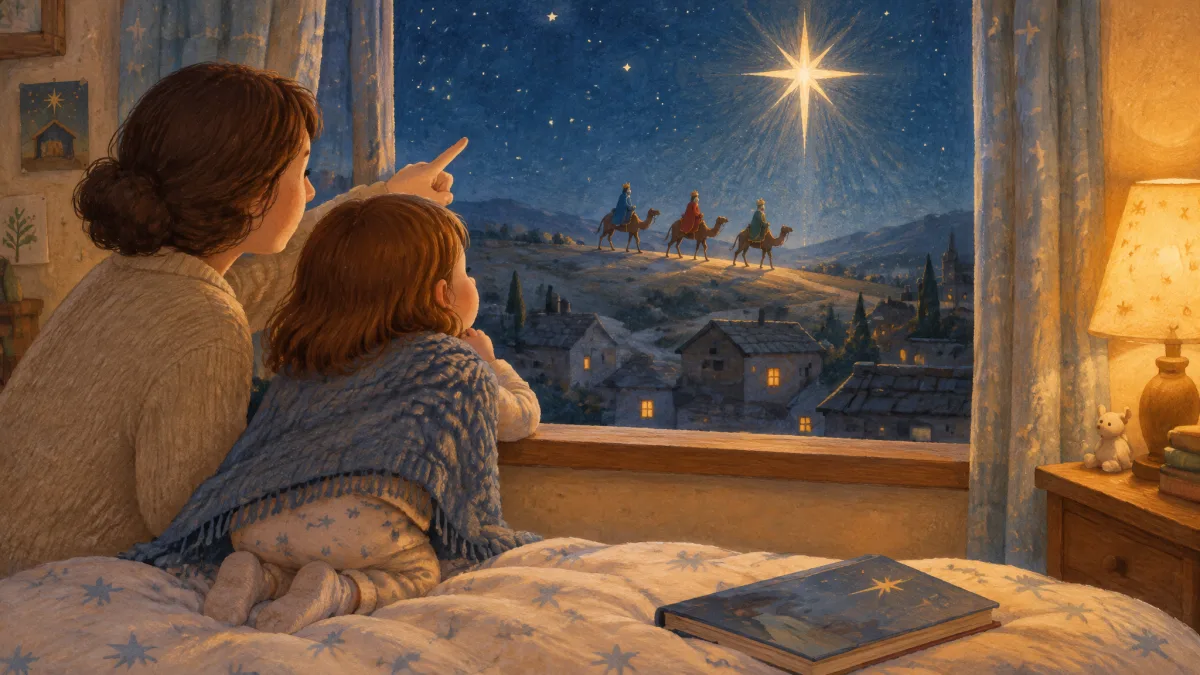
The Three Kings story for kids (2027): a 5-minute version to read aloud on the night of 5 January
The story of the Three Kings, told simply: wise men from the East saw a new star, followed it all the way to Bethlehem and found the child Jesus with his mother Mary. They gave him gold, frankincense and myrrh, then went home by another road after a dream warned them to stay away from King Herod. Below is a complete version for ages 3 to 8 that takes about 5 minutes to read aloud, written for this page, faithful to the Gospel of Matthew and gentle enough for the night of 5 January.
One honest note before you start: the Gospel never says there were three of them, never calls them kings and never gives their names. Those details came later, and the FAQ explains where from. After the story you will find how 6 January is celebrated from Spain to Denmark and, because Looma Stories makes personalized books, a short section on putting your own child in the story. The story comes first.
Follow the star: the Three Kings story
Ages 3 to 8, about 5 minutes. Why it works at bedtime: the same little question comes back on every night of the journey, so your child can say it with you, and the story ends with a sleepy child, a quiet road and a star still shining.
Far away in the East, where the sky is very wide, there lived three wise men who loved the stars. They knew every star by its place, the way you know every toy in your room.
Their names, the old stories say, were Melchior, who had a long white beard; Caspar, who was young and could never sit still; and Balthasar, who had the deepest, warmest voice.
One night Caspar jumped to his feet. "Look! A new star!"
It was brighter than all the others, as if it wanted to be followed.
Melchior opened his oldest book. "A star like this," he said slowly, "means a very special king has been born."
"Then let's go and find him," said Balthasar, "and bring him presents."
So they packed. Melchior chose gold, which shines like a little sun. Caspar chose frankincense, golden drops that make a sweet-smelling smoke when you warm them. Balthasar chose myrrh, a precious perfume kept in a tiny jar. They loaded their camels and set off.
Every evening, when the sky turned dark, one of them would ask, "Where is the star?"
And the other two would point and say, "There it is. Let's follow it."
They crossed sand that was hot all day and cold all night. "Where is the star?" "There it is. Let's follow it."
They crossed hills where the wind whistled and the camels grumbled. "Where is the star?" "There it is. Let's follow it."
At last they came to a big city called Jerusalem, with a palace. "A new king must be born in a palace," said Melchior. So they went to see King Herod, who lived there.
"Where is the child who was born to be king?" they asked. "We saw his star, and we have come to honour him."
King Herod did not smile. He did not like hearing about another king, not one bit. His learned men unrolled their old scrolls and said, "The child will be born in Bethlehem, a little town nearby."
Then Herod said, in a voice a little too sweet, "Go and find him, then come back and tell me where he is."
The wise men left the palace. Outside, the night was dark. "Where is the star?"
And there it was, shining again, brighter than ever, going ahead of them along the road to Bethlehem. Caspar laughed out loud, and even the camels walked faster.
The star went ahead, and ahead, and then it stopped, right above a small house with a warm light in the window.
The wise men climbed down from their camels and knocked very softly. Inside they found a mother, Mary, and her little child, Jesus. No palace, no crown. Just a mother and a child, warm and sleepy.
The wise men knelt down on the floor. Melchior gave the gold, and it glittered in the lamplight. Caspar gave the frankincense, and the room filled with a sweet smell. Balthasar gave the myrrh in its tiny jar. The child looked at them with big, shining eyes.
That night all three wise men had the same dream: "Do not go back to the palace. Go home by another road."
In the morning they looked at each other. "Did you dream it too?" They did not go back to King Herod. They took another road, and the child stayed safe with his mother and with Joseph, who looked after them both.
The road home was long, but every evening one of them would still ask, "Where is the star?" And the others would smile and say, "We followed it. We found him."
Ever since, the wise men have been remembered on the night of 5 January all over the world, with a cake, a song, a candle or a star carried from door to door. Tonight, look out of your window and find the brightest star you can see. Then snuggle down. The wise men are on their way home, and you are home already. Goodnight.
How 6 January is celebrated, country by country
The feast is called Epiphany, and the wise men are at the heart of it almost everywhere in Europe, but every country keeps it its own way. If your family comes from somewhere else, the line for that country is a good thing to tell your child after the story.
| Country | Name of the day | What families do |
|---|---|---|
| Spain | Día de Reyes | Children write a letter to the Kings, watch the cabalgata parade on the afternoon of 5 January and set out their shoes and a snack for the Kings and their camels before bed. On the day: roscón de Reyes, a ring cake hiding a bean and a little figurine. |
| Italy | Epifania | Children hang a stocking for the Befana, who flies on her broom on the night of 5 to 6 January and fills it with sweets, or coal for a little mischief. |
| Portugal | Dia de Reis | Groups sing the Janeiras and Reis songs outside people's homes. Families eat Bolo-Rei, a crown-shaped cake that used to hide a dried bean: whoever found it bought next year's cake. The decorations come down. |
| France | Épiphanie | Families share a galette des rois. The youngest sits under the table and calls out who gets each slice, and whoever finds the fève wears the crown. |
| Germany and Austria | Heilige Drei Könige | The Sternsinger, children dressed as the kings and carrying a star, go from door to door collecting for children's projects and write the blessing 20*C+M+B+27 in chalk above the door: "Christus mansionem benedicat", Christ bless this house. |
| Poland | Trzech Króli | Towns hold the Orszak Trzech Króli, a street parade with crowns and carols. Families write K+M+B or C+M+B and the year above the door in blessed chalk. |
| Netherlands and Flanders | Driekoningen | Children dressed as the three kings go from door to door singing and are given sweets. It is not an official holiday. |
| Sweden | Trettondedag jul | A public holiday. Star boys (stjärngossar) once walked from house to house telling the story of the wise men, and a few processions still take place. |
| Finland | Loppiainen | A public holiday that marks the end of the Christmas season. |
| Denmark | Helligtrekonger | On the evening of 5 January some homes light a three-armed candle, one light for each wise man. |
Make your child part of the story
The easiest way costs nothing. Tonight, after the last "Goodnight", ask your child which present they would have brought, and where they would have ridden in the caravan. Small children love to add themselves to a story they already know. If you want to write it down, the fill-in template in our Christmas story starring your child works for the Kings too: swap the sleigh for three camels and the chimney for a star.
If you would like it as a real book, this is what we make at Looma Stories. You upload a photo of your child and they become the illustrated hero of the book, drawn from their photo, and you can add up to four other characters, a big sister or a grandparent for example, each from their own photo. Then you write the story idea in your own words. For example: "Mia, 5, rides with the three wise men for one night, helps them follow the star across the desert and gives the baby her favourite blanket. Gentle, ends with Mia asleep at home on the morning of 6 January."
The eBook costs €3.99, paid when you order, and it is ready in about two hours. You then read the whole book, change any word and have pictures redrawn. A printed hardcover is optional, with delivery priced at checkout. You can start your story here.
FAQ: what parents ask about the Three Kings
Were there really three kings, and what were their names?
The Gospel of Matthew, the only Gospel that tells this story, speaks of "magi from the east" without saying how many there were, without calling them kings and without naming them. The number three most likely comes from the three gifts, and Christians in the East, especially in Syria, often spoke of twelve. Later readers called them kings, after verses in the Psalms and Isaiah. The names Melchior, Caspar and Balthasar appear in a Latin chronicle and on a 6th-century mosaic in Ravenna, Italy, and have stayed ever since.
What are gold, frankincense and myrrh?
Gold is the metal. Frankincense is the dried resin of a tree that gives off a sweet-smelling smoke when it is warmed. Myrrh is another fragrant tree resin, prized for perfume. All three were rare and precious, the kind of gifts you would bring to a king.
How do I tell the King Herod part to a small child?
The way the story above does: Herod was jealous of the new king, the wise men were warned in a dream, they went home another way and the child was kept safe. That is all a 3 to 6 year old needs. Matthew goes on to tell that Joseph took Mary and the child to Egypt until Herod died, and that Herod did something cruel in Bethlehem; many families keep that part for when children are older and ask for themselves.
What age is this story for, and how long does it take?
It is written for ages 3 to 8 and runs to about 650 words, so about 5 minutes at a calm bedtime pace of 120 words a minute. With a 3 year old, keep the repeated question and skip the palace scene if attention fades; with a 7 or 8 year old, stop at the star over the house and ask what they think is inside.
Can I still get a personalized book in time for 6 January?
Yes. For a printed hardcover to arrive before 6 January 2027, approve the story and order the hardcover by Wednesday 9 December 2026 at the latest for an address in the EU, or by Monday 7 December 2026 for the UK and Switzerland. After those dates choose the eBook: it is ready about two hours after you order and downloads as a PDF, so it can still be the surprise on the morning of the 6th.
Can I print this story or read it at school?
Yes. We wrote it for families and teachers to read aloud, so print it, read it to a class or in a nativity play, and change the details if you like. Please link back to this page if you share it online.