
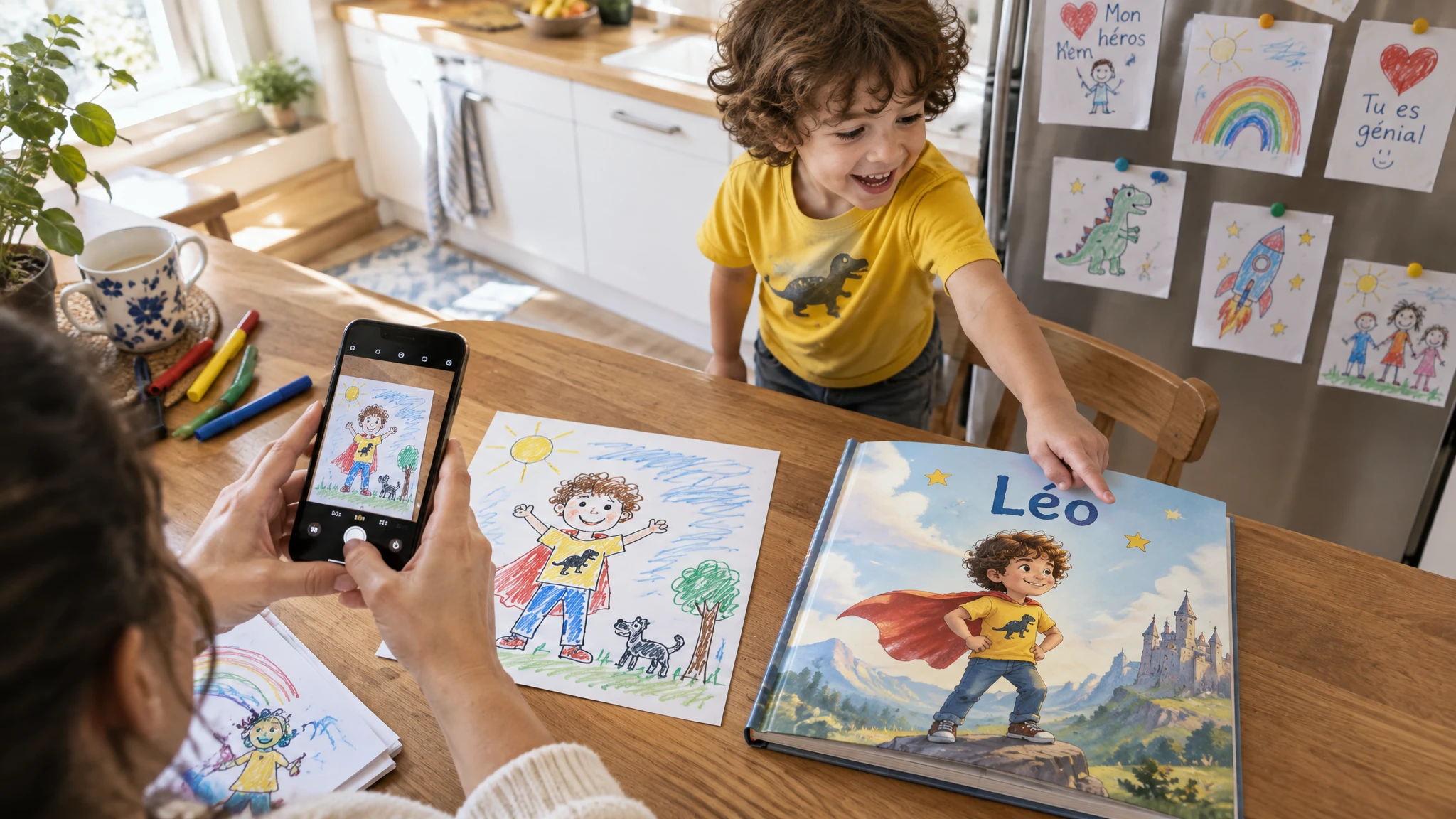
Turn your child's drawings into a book: the real options, and the one people forget
There are two ways to turn your child's drawings into a book. The first is to photograph or scan their artwork and print it in an album, with their own dictated comments as captions: that is the book of their drawings. The second is to make them the illustrated character of a story, starting from a few photos, which turns a photo into a drawing: that is the book where they are drawn. The first keeps what they made, the second puts them on stage, and many families end up doing both, at different times of the year.
Option 1: print your child's drawings in a book
This is the most literal answer to "turn a drawing into a book", and the easiest to do with any online photo book service. The result is a bound album in which each page reproduces one piece of artwork. The secret of a good book of drawings is not the printing, it is the selection and the captions.
- Choose between 20 and 40 drawings. Not all of them. One book per school year or age bracket is the format that gets re-read; the exhaustive binder never gets opened.
- Digitize them properly. A scanner at 300 dpi is ideal. Otherwise, photograph each sheet flat, in daylight, without flash, with the camera parallel to the paper to avoid distortion (see the tips below).
- Crop, but keep the white of the paper. Do not "clean up" too much: the fingerprints and the torn corner are part of the memory.
- Have them tell you about each drawing. Write down word for word what they say: "that's daddy running after the bus". That sentence, more than the drawing, is what will make you laugh in fifteen years.
- Date and title. Their age on every page, and a title they choose for the cover.
The book of drawings is a perfect gift for grandparents and a lovely way to clear the fridge without throwing anything away. It has one honest limit: the child leafs through it with pride, but does not ask for it at bedtime. It is not a story.
Option 2: turn your child into a drawing, in a story
The second reading of "turn your child's drawings into a book" is the one that most often comes up in parents' searches: they do not want to archive the scribbles, they want to see their child as a drawing, in a real picture book, with a story in which they are the hero. Here, it is not their artwork being transformed, it is their photos.
The principle: you provide a few clear photos of your child, and they become the illustrated character of an adventure written for them, in the art style you choose, watercolor, colored pencil, cartoon or animation. The likeness holds from page to page, which is what triggers in 3 to 6 year olds the "that's me!" that a name-only book never produces. Brothers, sisters and grandparents can join the story, and the book gets read at bedtime, again and again, which an album of drawings does not.
The honest limit of this option: it is not a book of their creations. If your goal is to keep what they drew, option 1 is the one you need.
Book of their drawings or book where they are drawn: the comparison
| Book of their drawings | Book where they are drawn | |
|---|---|---|
| What it keeps | Their artwork, as it is, with their words | Their face and personality at that age, in a story |
| The child's role | Author: they did everything | Hero: everything was done for them |
| Preparation time | One to two hours of sorting, photographing and captioning | A few minutes, to choose photos and read through |
| What the child does with it | Shows it, leafs through it, puts it away | Asks for it to be read, at bedtime, for a long time |
| Best for | Grandparents, end of the school year, the memory box | Birthday, Christmas, the bedtime ritual, siblings to bring together |
| What it is not | A story | An archive of their creations |
How to photograph a drawing so it prints well
If you do not have a scanner, a recent phone is enough, provided you follow four rules.
- Indirect daylight, never flash. Near a window, out of direct sun, to avoid glare on felt-tip marker and blown-out areas on the white.
- Flat, camera parallel to the paper. Lay the drawing on the floor or a table and hold the phone directly above it, pointing straight down. An angle turns the rectangle into a trapezoid and you will have to straighten it.
- Fill the frame, then crop. Get close enough that the sheet fills almost the whole image without cutting the edges, then crop precisely afterwards.
- Aim for 300 dpi at print size. For an A4 or US Letter page, that is about 2,500 by 3,500 pixels; any phone from the last ten years delivers that. Check the photo is sharp by zooming in on a pencil line.
One last tip: photograph as you go, the same evening, rather than in one catch-up session on a Sunday in November. That is the difference between a finished project and a folder of 400 photos.
What if you did both?
It is not a final choice. Many families make the book of drawings in June, at the end of the school year, as a round-up to give to grandparents, and the book where the child is the hero for Christmas or a birthday, as a gift to unwrap. The first goes in the memory box, the second on the bedside table. And sometimes the second inspires the first: a child who has seen themselves as an illustrated hero often starts drawing the next chapter of their adventure, and those drawings deserve their own book the following year.
Where a personalized book fits
We make the second option at Looma, so take this paragraph for what it is. From a few photos, your child becomes the illustrated hero of a 36-page story written for them, with up to four other characters, in the art style you choose. You read and edit everything before paying; the ebook is instant, the printed hardcover optional. Our photo book reinvented page explains how their photos become drawings, our personalized children's book page shows examples, and you can start their book in a few minutes. For a book of their own drawings, any good photo book service will do; we do not make those, and the tips above apply to all of them.
FAQ: frequently asked questions
How do I turn my child's drawings into a book?
Select 20 to 40 drawings, scan them at 300 dpi or photograph them flat in daylight, write down word for word what your child says about each one, then print them in an online photo book with their age and captions. One book per school year is the format that gets re-read most.
Can you turn a photo of a child into a drawing for a book?
Yes. Some personalized books draw the child from their real photos and make them the illustrated hero of a story, in a watercolor, colored pencil or cartoon style. It is not an album of their creations but a book in which they recognize themselves, to read at bedtime. Check that you can preview the whole book before paying.
What resolution do I need to print a child's drawing?
Aim for 300 dpi at the final size: for an A4 page, about 2,500 by 3,500 pixels. A desktop scanner or any recent phone gets there, provided you photograph flat, without flash, in indirect daylight, and check sharpness by zooming in on a line.
How many drawings do you need to make a book?
Between 20 and 40, which makes a book of 24 to 48 pages depending on the layout. Fewer, and the object feels thin; more, and nobody leafs through to the end. If you have 200, make three books by age bracket rather than one doorstop.